

The Scottish Government has taken a step towards better buses in Scotland but “public control” isn’t the same as “public ownership”.
There was a subtle trick in John Swinney’s conference speech about public bus policy that may have caught some folk out. This is intentional. Politicians like it when you support the policy in your head when, in fact, you’re endorsing the one in theirs.
The trick was that the Scottish Government wants to bring the bus network under public control. What he wants everyone to hear is that it will come under public ownership. There is a big difference between the two that is worth laying out.
If the difference caught you, don’t worry. It seems to have caught some of the owners of Scotland’s private bus companies who have already leapt to the conclusion that this will be a ‘Mugabe-style land grab’ against their property.
Swinney was right to dismiss this comment as ludicrous but it should also be quite liberating for him too, if he wants it to be.
I’ve said this many times, including directly to the faces of Government Ministers. If your opposition throws every toy out of every pram and treats the mildest reform as the exact same as the most radical possible option then the political capital you need to spend to overcome that opposition is exactly the same in both cases too. In which case, there’s never been a better moment to do the radical thing instead of the mild reform.
To give an example from tax – if the opposition will oppose a 1p top rate increase with the same screaming match as they would a comprehensive package of equality measures, including land taxes and other wealth taxes, then you might as well do everything.
To bring this back to buses, if the opposition are going to treat a small regularisation of public policy and management as if it was full-scale nationalisation, then they can’t complain any harder if it WAS full-scale nationalisation.
The plan as it stands is quite mild. It’s about giving public authorities power to determine routes, fares and identifying areas where service is lagging behind demand (something that could be particularly useful where deprivation or rurality leads to less profitable service). There seems to be a plan for franchising system to be put in place and companies both public and private may or may not be able to bid for the various contracts. It may be less CalMac and more Abelio-era Scotrail.
There are questions over who will control those contracts and planning. Right now, it would obviously be a role for Local Authorities but the Scottish Government has also committed to radical reform that may involve dividing Local Authorities between Regional Authorities and more municipal scale District Councils. There is a good case to be made to put most of the powers over buses into the regional level (It appears that Get Glasgow Moving’s campaign for Better Buses, including their joint policy paper with us, has played a major role in Swinney announcing this policy) but I’m not sure it’s entirely a hard-and-fast case. Consider, as one example, the role of a single-route community-owned bus that takes folk from the village into town. This is both a service that it would make much more sense to run from a municipal level and I would worry about its future if a relatively remote Regional Authority could hand the route franchise to a major corporation instead.
Similarly, we cannot simply replicate the current system whereby private companies are able to cherry-pick only the most profitable routes and leave the less profitable or vital-but-loss-making ones to others. At the very least, these new regulations should ensure that routes are bundled in a way that best serves everyone. I have more to say on this point that I’ll have to save for a future article but Britain still has a bad post-Thatcher hangover where we treat too many vital utilities not as vital public services provided on a universal basis rather as market commodities to be rationed to those rich enough to be able to afford them and to be profited from by the even richer.
But let’s say that all of those issues are worked out (maybe there’s a carve out for local and community owned groups so long as they meet the minimum standards set by the Regional or National regulations). Let’s say we still want true public ownership within this system.
“We could go further and state that companies must actually be public, community or mutually owned in order to bid for a route.”
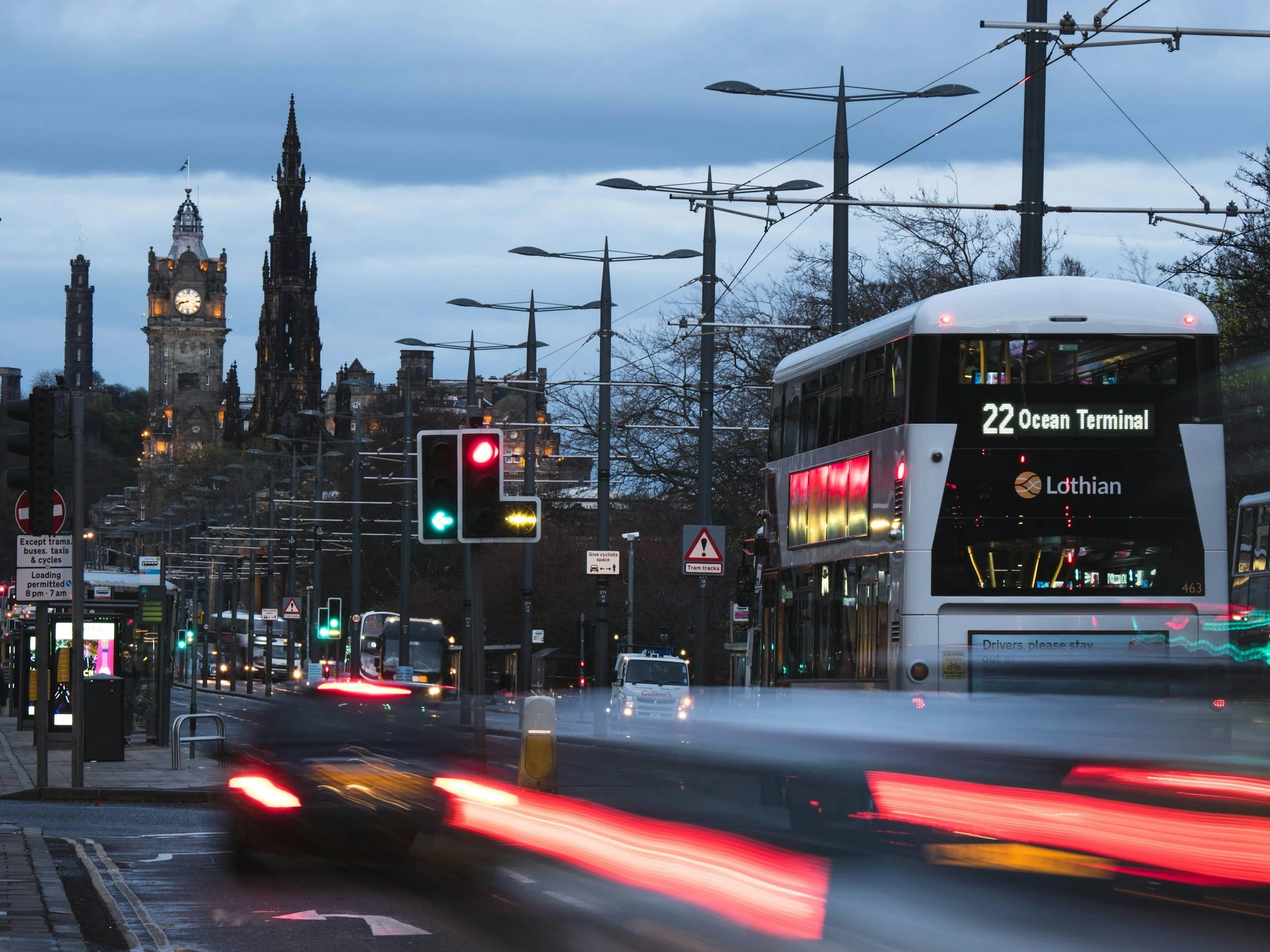
We learned how to do this through our campaign for a National Care Service. The tripwire that UK politics often falls over when it comes to public ownership is the problem of what to do with the existing private system. The simple solution of just buying it all out at market rate is both expensive and probably counter-productive (especially in an era where private equity has eaten many private assets and left debt-wracked shells in their place). Something we advocated for in care was that the tendering regulations for care homes that receive public money should be changed so that service providers operated on a not-for-profit basis. Rather than buying out private bus companies, Scotland could simply regulate such that the only companies who can bid for tenders for Scottish routes should follow principles such as Fair Work Principles, not-for-profit or that they should be publicly owned (following examples such as Lothian buses or the community bus mentioned earlier).
This wouldn’t mean that existing private companies would be nationalised, nor would it mean that they would be banned but clearly profit-making private companies would have to substantially change their business model in order to maintain routes (as we also learned in care, there are other ways to extract money from “not-for-profit” services – this would have to be tightly regulated too to avoid excess profiteering).
We could go further and state that companies must actually be public, community or mutually owned in order to bid for a route. Again, not one private company need be nationalised, but simply pushed to the side. This will probably have to be done anyway. If only private companies bid for the routes then they will use the threat of pulling out or not bidding in order to increase their power and profits – forcing them to compete (both on price for consumers and on wages and conditions for workers) against a credible public option will prevent this. This is another lesson to take from the care sector.
This would raise the question of where the new public companies would get the buses – we had advocated that rather than subsidise Alexander Dennis’ managed decline, the Scottish Government should have subsidised Councils to get orders in instead.
Of course, all of this is workaround. I’m not talking about this because the Scottish Government really wants to nationalise buses but is being prevented from doing so by the limitations of devolution (this is their line when it comes to public energy, but it’s not true there either). They’re doing this because they are under pressure on private bus profits and want to exhaust all options before being forced to nationalise buses.
Scotland already has a model of how to run publicly-owned buses both at a community and at a regional scale – all they need to do is do it everywhere.
That the Scottish Government has opened up this conversation is a major win for transport campaigners but it’s clear that more pressure is needed for them to realise that once they have exhausted all options, the only one that remains is a public transport sector that is publicly owned, not-for-profit, locally controlled and free at the point of use. Maybe, like buses are oft claimed to do, we’ll have to wait only a little longer before all of them turn up at once.
