

How to profit from not-for-profit care
Common Weal’s latest policy paper discovers that the Scottish Government’s commitment to limit profit in children’s care is likely to face obstacles as there are many more ways to extract money from “not-for-profit” work than the narrow definition of “profit”.
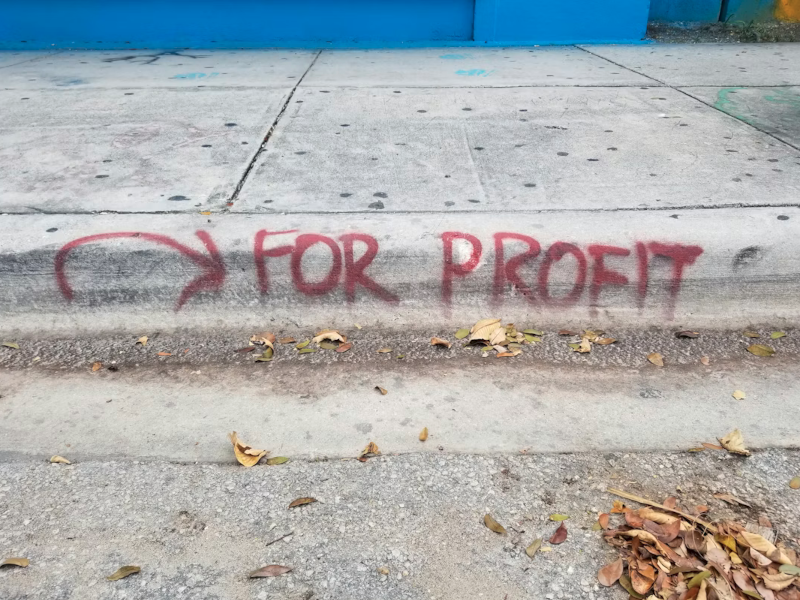
Image Source: George Pagan III, Unsplash
I would like you to image the following scenario: You are a company owner or shareholder. Like every ‘good’ Capitalist, you want to leverage your assets to make as much money as you can. The issue is that you work in a sector where making a profit has been deemed by the Government to be unacceptable and they have banned you from making one. How do you extract as much as you can?
As a bit of background, this thought experiment stems from the conclusions of our latest policy paper, Why and how the Scottish Government must end private provision of children’s care, which has found that private companies, including ostensibly ‘not-for-profit’ companies, that deliver children’s care services are extracting an average of £28,000 per child per year from care services. This includes an average of £9,000 per child per year from foster care specifically where, in Scotland, it is explicitly illegal to make a profit..
These findings have come off the back of the Scottish Government making a pledge to eliminate profit from children’s care and they themselves have described our findings as “shocking”, though they are sticking by their current action plan to merely “limit” profit in such care. The problem as we see it though is that there are various mechanisms open to companies to allow them to extract money from the system in ways that wouldn’t be counted as ‘profit’.
This is because ‘profit’ has very narrow meaning in this context. It’s just what a company has left over after all of its expenses are subtracted from its income. In a for-profit company, this is often distributed to owners and shareholders as a dividend (see my recent article on the financialisation of housing and why that is costing you an average of £67,000 in extra mortgage payments for an example of this in action).
It would be perfectly possible for the Scottish Government to ban the sharing of such dividends for children’s care services and to legislate that only not-for-profit companies can bid for care contracts. However, this is not enough to prevent people from making money from children’s care. To that end, we’ve concluded in our paper that the only way to avoid profit extraction from children’s care is to bring the whole sector into public ownership.
If we don’t, then we’ll just end up with ‘profit’ being shifted into some of the following means of making money without making a profit.
1. Pay yourself as much as you need
The simplest and easiest way of extracting money now that your company has been banned from giving you a dividend, is to simply pay you more. Whatever the company’s surplus was last year, you can just pay to yourself as a salary. There will be tax implications for this – you’ll be paying income tax instead of Capital Gains tax so, especially in Scotland, the tax on your earnings will be substantially higher than if you were paying yourself a dividend, but that might still be worth it.
We found examples of children’s care companies in Scotland where the Director was being paid almost £350,000 per year – and we’ve found similar examples in other ‘not-for-profit’ care sectors like social work. This is more than twice the annual salary of the Scottish First Minister. Note that these high levels of pay often do not filter down to the front-line care staff who are, in fact, often paid less than their public sector counterparts as well as losing out on benefits and rights such as better conditions or union representation. While it is important to ensure that expenditure matches income to avoid ‘profit’, it’s clear that some expenditures are more worthy than others…
This is one area that might still be an issue if the sector is brought into public ownership – a prominent current example is the dispute over the pay rises granted to Scottish Water executives. However, this is still a better idea than the current system allows for. Partially because the Scottish Water scandal is a scandal precisely because it is public owned.
This means that such pay is democratically accountable and Ministers can be challenged for their oversight and the executive salaries are all public knowledge rather than being hidden or woven through opaque company accounts (in our report we couldn’t track down the executive pay of more than a couple of companies because some simply do not disclose it). Also though, Scottish Water has a near-monopoly on service provision in Scotland because it is public owned. In the care sector it’s not just the Director of one company whose salary is under question but multiple companies all working all across the care sector.
2. Lease yourself to yourself
If your care company is banned from making a profit then you can split that company into two. The ‘not-for-profit’ company that actually provides the care services might be banned from making a profit but the for-profit company that is also owned by you is the one who owns the building that the not-for-profit uses. This company charges a lease to the not-for-profit for the use of the building that just so happens to be high enough to eat their operating surplus.
‘Management Fees’ are another way of making these kinds of transfers from a subsidiary to a parent company and come with the added benefit of not being tied to a physical asset like a building and thus there’s no risk of someone noticing that you’re charging far higher rents than would be expected in the local market.
This is also a common tactic amongst multinational companies who want to shift money into tax havens or ‘tax friendly’ institutions. Coffee company Starbucks is well known for buying its coffee beans via a subsidiary company in Switzerland and charges its UK and other branches just enough for those beans to conveniently make sure that their UK outlets never make a ‘profit’ and thus pay little tax in the UK.
3. Give out a loan, and make them pay it back
One of the touted advantages of being owned by a larger company is that they can bring investment cash your way that wouldn’t otherwise be possible to get. Of course, investments always demand a return and the money your parent company loans to your subsidiary (remember, in this scheme you own both companies) should be paid back... with interest.
Even better, because this is an internal company loan rather than one via a regulated bank, you can charge whatever level of interest that you like and easily tailor the repayments to ensure that the not-for-profit company never makes a profit. If you ever wonder why profitable companies end up completely loaded with debt just a few years after being bought out by a global equity fund, this is very likely what has happened.
4. Receive a loan, and keep it.
It doesn’t need to be the parent company passing debt down, of course. This kind of financial transaction can happen the other way too. If the not-for-profit finds itself with a substantial surplus that it can’t get rid of before tax day, then it can loan that cash to the parent company or its Directors (e.g. you). The difference here is that you don’t charge above market rates for this upwards loan.
Maybe you don’t charge any interest at all. Maybe you don’t even expect the parent company to repay the loan ever. Sure, it’ll appear on the parent company’s books as a debt and that could be a problem in certain circumstances but there’s an easy way to deal with that. Simply wind up the not-for-profit company and the debt can be written off and the parent keeps the cash.
How to avoid profit in children’s care
The Scottish Government’s response to our paper was that the figures involved - £28k profit per child, per year – are “shocking” but also that they are not going to deviate from their paradoxical position that while any profit in children’s care is unacceptable, they are merely going to legislate to “limit” it.
As I hope we’ve seen here, that isn’t going to be enough. Even if the ‘limit’ on companies making a ‘profit’ from children’s care is set to zero, it won’t prevent those companies from extracting money from care or – by dint of paying workers as little as they can get away with – from carers. The only solution we can see is to bring the entire children’s care sector – both residential care and fostering – into public control.
This would, of course, be easier if we had a National Care Service to oversee the whole process but the failure of that Bill this year means we’ll need to take a more roundabout way of doing things. We still support an NCS and want to see it created in the next Parliament but children and carers can’t wait till then when we have opportunities now.
The next stage for our work on this will be to try to work out how much it will cost to bring that care into public ownership. We’re stymied by lack of data in this respect but early figures indicate that it might not be as huge of a problem as some fear – possibly on the scale of tens of millions of pounds rather than hundreds of millions. In this respect, it’s probably not dissimilar to our per capita estimates for nationalising all care in Scotland. After all, once we accept that it’s not acceptable to make a profit from caring for children, why should we treat adults any different?
