

Farewell Auld Reekie, onwards the dear green place
Rory Hamilton says his non-New Year’s resolution to carry something forward from 2025 into 2026 and to leave something behind in 2025 is no better embodied than in his moving from Edinburgh to Glasgow.
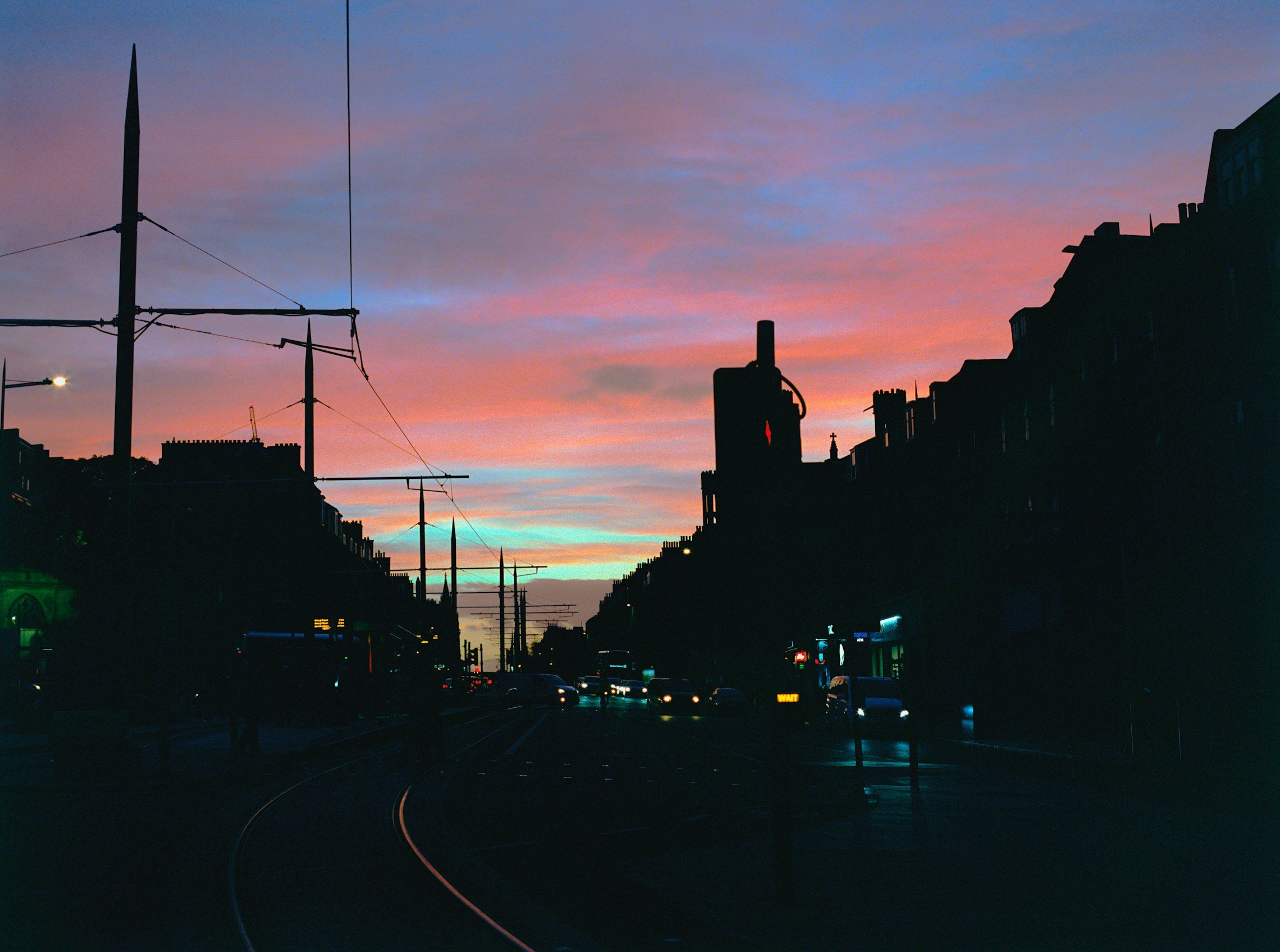
Sunset on Edinburgh
This year I am not doing New Year’s resolutions. Instead, I am choosing one thing to carry forward from 2025 into 2026, and one thing to leave behind in 2025. Why? Well, forming new habits takes time and we constantly fail, and the lessons we learn from failure are often a valuable experience. And so rather than wishing to add a whole new facet to myself which inevitably peters out by February, and feeling disappointed, I want to build on the success of my resolution this year to be more bold.
Gramsci himself hated New Year’s, “I want every morning to be a new year’s for me. Every day I want to reckon with myself, and every day I want to renew myself.” I think it is this ongoing process of renewal which being bold assumes and which by continuing to renew the meaning of it in 2026 I can reckon with myself, to use Gramsci’s words.
Being bold was about taking chances, asking that person for a coffee, getting that tattoo, making those introductions at conferences. It meant pushing myself out of my comfort zone, and out of it came opportunities for me that I’m not sure would have materialised otherwise.
One such opportunity is moving to a new city. Indeed, I am leaving behind the cobbled streets of Edinburgh for the red stone of Glasgow. Glasgow, a bold city if ever there was one – the spirit of the Red Clydesiders finds itself across the city today, in the striking workers at the Village Hotel and Vue Cinema, in the direct action by Living Rent to get a meeting with Susan Aitken.
But there is a meekness too. Leader of the Council Susan Aitken says, “the narrative of decline in the city is absolutely false,” but to be quite honest I think failing to acknowledge the problems in the city does it a disservice. Because it is the case that the city is very much alive and thriving in many parts, and in fact I think the branches extending over from Edinburgh (the West End accent, management consultancies, and the increasing colonisation of the South Side by the disciples of Carhartt), represent very strongly that the city does indeed work for some people. It’s why, when Living Rent confronted Susan Aitken over underinvestment in public services at the Glasgow City Council State of the City Economy conference in the Fruitmarket last month, she pleaded that the business leaders in the room were “Glaswegians too.”
And I do wonder of Glasgow City Council, as I do of the Scottish and UK Governments, are you not embarrassed by your lack of ambition? Why be so content with your comfort, that you fail to aspire to a city, a country, that works for all?
During COP26, delegates received free travel, a scheme SPT is now finally trialling for Glaswegians next year. The Commonwealth Games is coming to Glasgow in 2026, and yet the redevelopment of George Square will not be accelerated to provide a welcoming entrance to the city for visitors, the refranchising of buses wont have even got underway, and the non-introduction of the visitor levy all but guarantees the loss of a substantial cash injection into public services (the money from which, by the way, GCC would rather spend on marketing, than making the city liveable – “come to our great city, you’ll never be able to leave”). At the same time derelict buildings the city over are a blight on a city of once great architecture – the Egyptian Halls, Carlton Place, the Lyceum Cinema in Govan, held hostage to negligent vampires speculating on value and sucking the life out of places.
“But all of this is framed around making the city great for visitors, why not make it great for inhabitants?”
I love Glasgow, but I will be sad to say goodbye to Edinburgh as my home. It is by no means the perfect city, whether it’s the creeping gentrification through a private rental market catering for Fringe visitors, Purpose-Built Student Accommodation jacking up rents, or the disneyfication of the city centre with tacky Christmas markets, and endless Harry Potter shops making it a “must visit” purely for performative reasons. There are lots of things that could make the city better.
But the city is well-connected – I think I could get anywhere in roughly 30 mins. The public ownership of Edinburgh’s buses is absolutely something to be proud of, they are more often than not on time, they serve all parts of the city, prices are capped, and its speaks volumes of the amount of bus drivers I see kicking around the city centre centre during changeovers (abundant staff indicates good conditions). With tram expansion to come, I do think that’s ambition for the city, although not ambition that should come at the expense of the Roseburn Path, which marks one of the many wonderful green spaces and walks in the city.
“I want every morning to be a new year’s for me. Every day I want to reckon with myself, and every day I want to renew myself.”
Whether its Glasgow or Edinburgh that captures your heart I do think there’s a clear difference between the two. I always say to people, go to Edinburgh for the beauty of the city, the buildings and the parks, go to Glasgow for the people (clichéed I know). But it is true – and this is what I think frustrates me, and why I am making a plea for GCC to be more bold in 2026. Glasgow could hands down be the better city, the historical architecture and some of the green spaces and cultural sites are brilliant, but the potential of the place is being squandered to the dismay of the people who make it.
The remnants of the city’s beauty (which of course was built off the slave trade), are but a constant reminder of what Glasgow could be like. People want to be proud, and want to say ‘visit our city’ without the constant caveats. It’s about time Glasgow City Council embraced the bold demands of workers and tenants in the city, and left behind their meekness in managing decline.