

From the sexualisation of schoolgirls to violence within intimate relationships, women's safety is too often framed around identifying dangerous men rather than preventing harm. We must stop treating women's vigilance as a substitute for meaningful action.
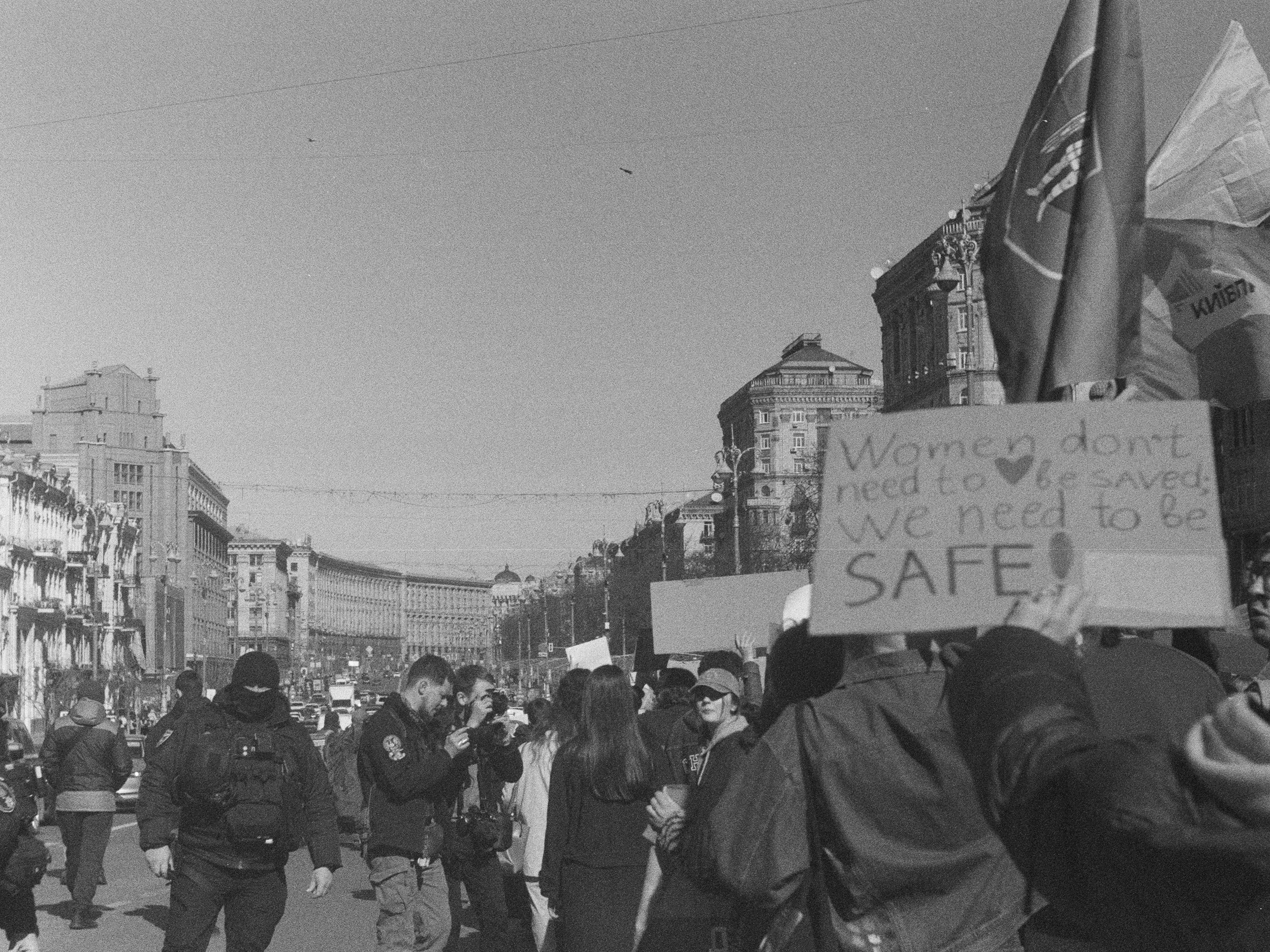
I was catcalled more often while wearing my school uniform than at any other point in my life.
There is something particularly unsettling about being sexualised when you are still a child, dressed for an institution that is supposed to protect you. You are walking to school or home from it, doing something entirely ordinary, when a stranger makes you conscious of your body, how it looks to them, and what they feel entitled to say about it.
You learn to ignore it, to keep walking, perhaps to change what you wear or where you go. You become accustomed to thinking about how other people might behave towards you, and what you can do to avoid it. Without anyone explicitly telling you so, the responsibility for managing the situation shifts towards you.
I thought about this recently after reading about four girls, aged 14 and 15, campaigning to ban school uniforms from being depicted in pornography. They argue that new restrictions on pornography depicting people pretending to be under 16 will leave a loophole for adults dressed as older schoolchildren. Their concern is that clothing designed to signify childhood and education is being turned into a sexual fantasy.
The girls describe becoming uncomfortable wearing their uniforms outside school, and worrying about photographs of themselves being taken and used in sexualised contexts. They have been inundated with accounts from other women and girls who experienced similar harassment, in some cases decades ago.
What struck me was not simply the existence of the loophole they want to close. It was that children had been left to campaign against a culture they felt was making them unsafe. They were having to explain why they should be able to wear their school uniform without worrying about how adults might sexualise them.
There is a familiar pattern here. Women and girls learn to anticipate unwanted attention, adjust their behaviour and make calculations about their own safety. We call this being careful. We rarely stop to ask why it has become so ordinary.
Scotland's latest homicide figures offer a stark reminder of why that question matters. In 2025–26, 56 people were victims of homicide, nine more than in the previous year. The long-term trend remains downward: the annual total is 54% lower than it was twenty years ago. That progress matters. But the circumstances of the deaths tell us something that the overall figures cannot.
Of the 15 female homicide victims, ten were killed by a current or former partner. Among male victims, the most common relationship to the accused was acquaintance.
These are small numbers, and homicide statistics cannot tell us everything about violence against women. But they expose a reality that is easy to overlook when public debate concentrates on dangerous strangers: for women, the person who poses the greatest threat may be someone they know intimately, someone they live with, or someone they once trusted.
Violence within relationships is not always visible to outsiders. It can exist alongside affection, financial dependence, shared responsibilities and the expectation that a relationship should be preserved. Coercion and control may precede physical violence, but the person experiencing them is often left to recognise the warning signs, manage the consequences and decide when the situation has become dangerous enough to seek help.
The danger is not confined to any one background or social group. Yet public discussion about violence against women can become fixated on identifying a particular kind of man: the stranger, the predator, the foreigner, the obvious threat.
Consider the recent controversy over a government booklet for asylum-seekers explaining British laws on consent and rape. The booklet prompted criticism from politicians who argued that it reinforced the perception that migrant men pose a particular danger to women. The debate was intensified by claims that Afghan men are more than twenty times as likely as British men to commit sexual offences.
An analysis by The Economist, using Ministry of Justice data obtained through freedom-of-information requests, found that the twenty-times claim relied on an unreliable estimate of the Afghan population. Its own age- and sex-adjusted analysis estimated that Afghan men were convicted of sexual offences at seven times the rate of British men over the period examined, while acknowledging substantial uncertainty. Four-fifths of the recorded sex offences in its dataset were committed by British people.
“We cannot prevent every act of violence. But we can stop treating women’s vigilance as a substitute for prevention.”
These findings require care. They do not establish that offending rates are identical across nationalities, and they do not justify dismissing crimes committed by migrants. But they demonstrate why claims about crime and immigration must be examined rather than repeated as political fact.
More importantly, they raise a question about the way we discuss women's safety. Why does the issue so readily become a debate about who belongs in Britain, and which groups should be regarded with suspicion?
There is nothing wrong with explaining British law to people arriving in the country. Everyone should understand that rape is a crime and that consent matters. But a leaflet is not a prevention strategy, and sexual violence is not a problem that begins at the border.
The Scottish homicide figures make that clear in a different way. Most of the female victims in 2025–26 were killed by partners or former partners. These deaths cannot be directly compared with the sexual-offence data, which cover different crimes and populations. But they challenge the reassuring idea that women can be protected simply by identifying a dangerous outsider and keeping him at a distance.
The problem with that idea is not that strangers never pose a threat. It is that it offers a reassuringly simple solution to a much more complicated problem: identify the dangerous men, keep them at a distance, and women will be safe. But for many women, the person who poses the greatest danger is already part of their lives.
What connects these different experiences is not that they are equivalent, but that they raise a question about responsibility. When women and girls experience sexual harassment or violence, how much of the response is directed towards changing the behaviour of those responsible, and how much towards helping potential victims manage the risk?
Girls are warned about what they wear and where they go. Women are encouraged to recognise warning signs, avoid confrontation and make plans to leave dangerous relationships. Such precautions can be important, sometimes lifesaving, but they cannot replace a wider effort to prevent abuse. A woman can take every recommended precaution and still be harmed. Her safety cannot depend on her ability to predict another person's behaviour.
That distinction matters for policy. Prosecution and punishment are essential, but they come after harm has occurred. Prevention means challenging coercive control before it escalates, taking reports of harassment seriously, protecting children from sexual exploitation and ensuring that people seeking help are not left to navigate fragmented systems alone. It also means examining how institutions respond when warning signs emerge, rather than treating each incident as an isolated failure.
Scotland's justice secretary has pledged to prevent violence against women and girls, support victims and ensure violent men change their behaviour. The test is whether those commitments produce meaningful action beyond statements of intent. Education matters, but awareness campaigns cannot compensate for inadequate support, ineffective intervention or institutions that fail to act when someone is at risk.
The same principle should guide the discussion of sexual offending and immigration. Crimes committed by migrants must be taken seriously, just as claims about offending rates must withstand scrutiny. Nationality alone cannot explain sexual violence, and a focus on particular groups should not obscure the wider responsibility to prevent it. We should be able to discuss individual offending without stigmatising entire communities, while acknowledging that violence committed by men born and raised here demands the same serious attention.
I learned early that wearing my school uniform could change how strangers treated me. The girls campaigning now are asking why they should have to accept that as normal. Scotland's homicide figures point to a different, more devastating context in which women can be harmed by people they know and trust. Together, these examples challenge the idea that women's safety can be secured simply by teaching them to recognise the right threat.
We cannot prevent every act of violence. But we can stop treating women's vigilance as a substitute for prevention, and stop making their ability to anticipate harm the measure of whether society has done enough.
Women and girls should be able to live their lives without having to calculate, at every turn, how someone else might behave towards them.
