

Nick Kempe looks at the latest reports from the Scottish and UK Covid Inquiries and how they impact lessons that should be learned from the disaster that unfolded within care homes.

Both the UK-wide and Scottish Covid-19 Inquiries were set up in 2022 with similar remits. The UK Inquiry was to ”examine, consider and report on preparations and the response to the pandemic in England, Wales, Scotland and Northern Ireland, up to and including the Inquiry’s formal setting-up date, 28 June 2022”. The Scottish Inquiry was “to establish the facts of, and learn lessons from, the strategic response to the COVID-19 pandemic in Scotland” between 1st January 2020 and 31st December 2022. To date the UK Inquiry has cost over £200m and the Scottish Inquiry over £58.4m.
While the Scottish Inquiry is still taking evidence, the chair of the UK Inquiry, Lady Hallett, is now writing up her findings and recommendations. Her sixth report, on the Adult Social Care sector, containing eight recommendations and was published on 20th October. All but the last recommendation, about the registration of the adult social care workforce in England, apply to all four home nations.While clearly documenting the differences between the four countries, the report’s conclusion is that none were prepared. This is backed up by significant amounts of supporting evidence. For example, the percentage of deaths from Covid in care homes followed broadly similar patterns across the four home nations (see graph) while each also experienced spikes in “excess deaths” that appear to have been caused by the way lockdown was managed.
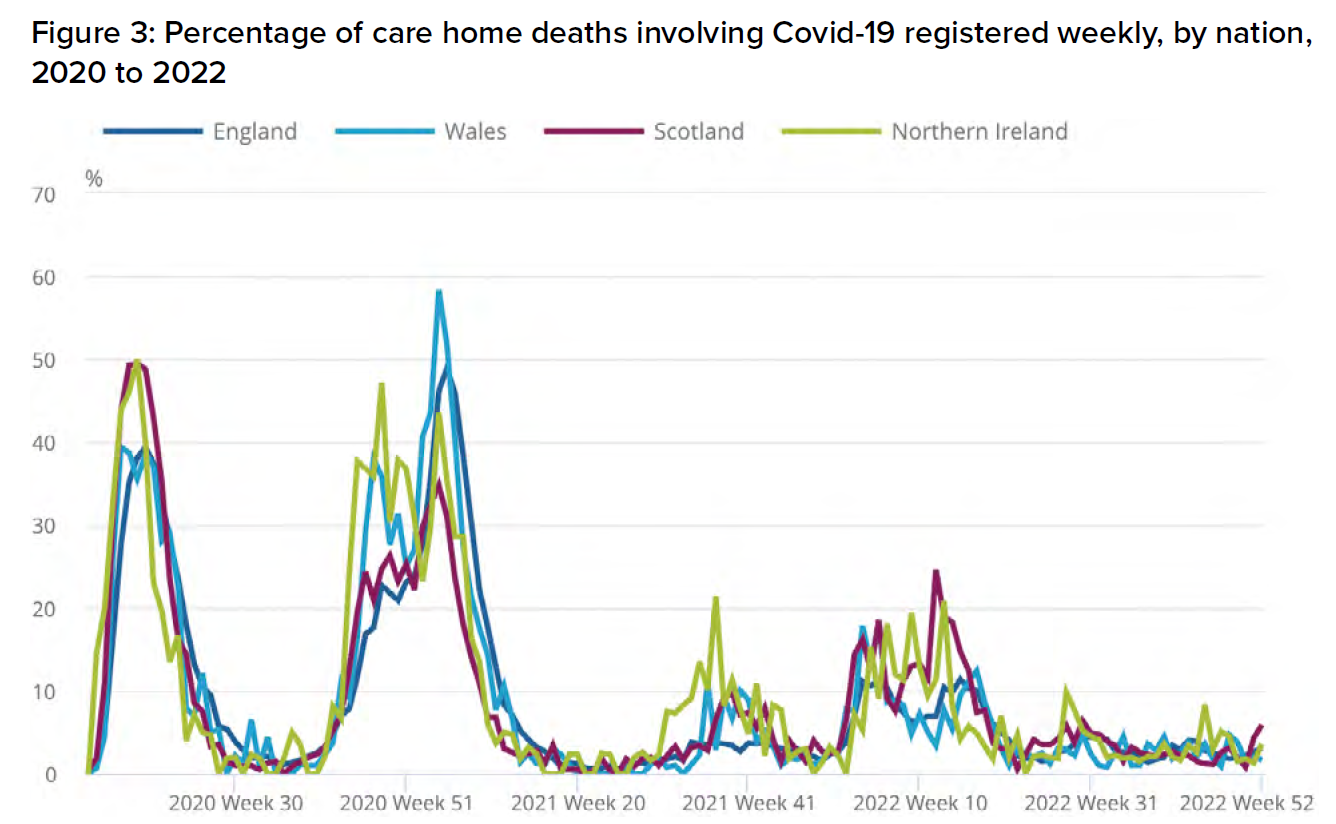
The report is therefore important in showing that the differences between the four countries have limited significance except for purposes of party-political point scoring. Its conclusion is the pandemic had a devastating impact “on the millions of people receiving adult social care and the many millions more who dedicate themselves to providing that care”. The recommendations that apply to Scotland therefore need to be taken seriously not least because, as Lady Hallett states in her accompanying letter to Andy Burnham, they need to be implemented swiftly to “prevent us from entering the next pandemic in the same vulnerable state as we entered the Covid-19 pandemic in 2020”.
Of these seven recommendations, the Scottish Government has broadly addressed Recommendation 4, Visiting Restrictions, through Anne’s Law (see here) so I won’t consider here although, like the other recommendations, it remains to be seen how it works in a crisis.
Unfortunately, none of the other six recommendations are likely to prevent another disaster in the next pandemic. This is because the limited remit of the Inquiry means it has not considered the structural issues and problems in the care sector which made the crisis so predictable (see here).
“While the public will rightly question the cost of these inquiries, £250m and rising, from the perspective of the two governments this is far cheaper than having to take any meaningful action.”
The first recommendation is about “Improved Pandemic Planning for the Adult Social care Sector”. The report marks a small step forward in recommending each care provider, as well as each level of government, should produce their own plans for responding to a pandemic. However, its recommendation that governments need to explain “how bed capacity and staffing levels will be tracked in care homes and domiciliary care” in a pandemic misses the point. Unless there is sufficient bed capacity and sufficient staffing to compensate for those who become sick or die in place before a pandemic, monitoring that inadequate capacity during a crisis will make very little difference.
Recommendation 2 is that governments should “record systematically the availability of isolation facilities in care homes in each nation and keep these up to date”. It assumes such facilities exist without saying how many are required. The truth is there is a need to redesign and upgrade almost every care home in Scotland so staff and relatives can care for and visit those are infected safety. But that would require significant investment, mainly by the private care home sector and detract from care home profits. As Craig Dalzell stated in Common Weal’s Daily Briefing (here), learning lessons about the pandemic in the abstract is one thing, taking actions that will make a real difference quite another.
Recommendation 3 is that governments should put place arrangements to “to protect adult social care staff against financial loss as a result of compliance with mandatory self-isolation rules”. Again, this misses the important point. When doctors in the NHS or their family members in Scotland have been physically sick, they are not allowed to go to work, to prevent the risk of infection spreading, but are still paid. That should apply to all staff but, rather than recommending the pay and conditions of the social care workforce needs to be improved, the message from Lady Hallett is that social care staff and infection control only matter in a pandemic.
Recommendation 5 is that the regulators, “develop adaptable protocols for carrying out on-site, hybrid and remote inspections in a future public health emergency”. Again, this only goes so far. The Care Inspectorate were allowed to go AWOL at the start of the pandemic, until the Scottish Parliament intervened, leaving poorly trained care home staff in the lurch. The much more fundamental issue, however, is that the Care Inspectorate had done almost nothing beforehand to ensure care providers were prepared for a pandemic. The case of Home Farm Care Home on Skye, which I described in a Predictable Crisis, where the CI had identified very serious failings in infection control before Covid and then failed to take action even as the Covid crisis unravelled illustrates the point. The consequences were as horrific as they were predictable. There is no reference to Operation Koper, Police Scotland’s investigation into care home deaths, in Lady Hallett’s report.
Recommendation 6 is that all four governments “should develop mechanisms to collect, analyse and publish data systematically about the deaths of adult social care workers during a pandemic.” Again, this misses the point. Reporting on deaths is far less important than preventing them from happening in the first place. But that would require care staff to be properly trained, properly equipped and working in facilities that were designed to reduce the spread of infection all of which would cost money.
Recommendation 7 is that health and care staff should have “mandatory end-of-life care training”. Part of the horror of Covid was the way many people died, alone, uncared for, separated from their families was often horrific, but again this recommendation misses the wider point for social care staff. First, care staff were often overwhelmed during the pandemic and without sufficient staff, these horrors won’t be prevented in future. Second, good end of life care is just one part of good care, so mandatory training for the former makes no sense, and will have very little impact, unless it is part of wider comprehensive training for adult social care workers. (NHS staff receive much more comprehensive training so this recommendation makes more sense for them).
In summary, the recommendations of the UK Covid Inquiry fail to address the underlying issues and let all four governments off the hook. It remains to be seen if the recommendations of the Scottish Covid Inquiry for the Adult Social Care sector will be any stronger but because its remit is similarly restricted that appears unlikely. While the public will rightly question the cost of these inquiries, £250m and rising, from the perspective of the two governments this is far cheaper than having to take any meaningful action. In thinking about how to prepare the adult social care sector in Scotland for the next pandemic the starting point should not be pandemic planning, which has a limited focus, but a properly resourced National Care Service, as we described in Caring for All here. Without a stable and sufficient workforce who are trained and equipped to do their jobs and far better support for informal carers, the consequences of the next pandemic will be as predictable as those of Covid.