

We cannot police our way out of the channel crisis
Fewer Channel crossings do not necessarily mean that deterrence is working. The emergence of mega-dinghies shows how quickly smugglers adapt when governments make existing routes harder. Britain can make the journey more dangerous, but it cannot make the reasons people are leaving disappear.
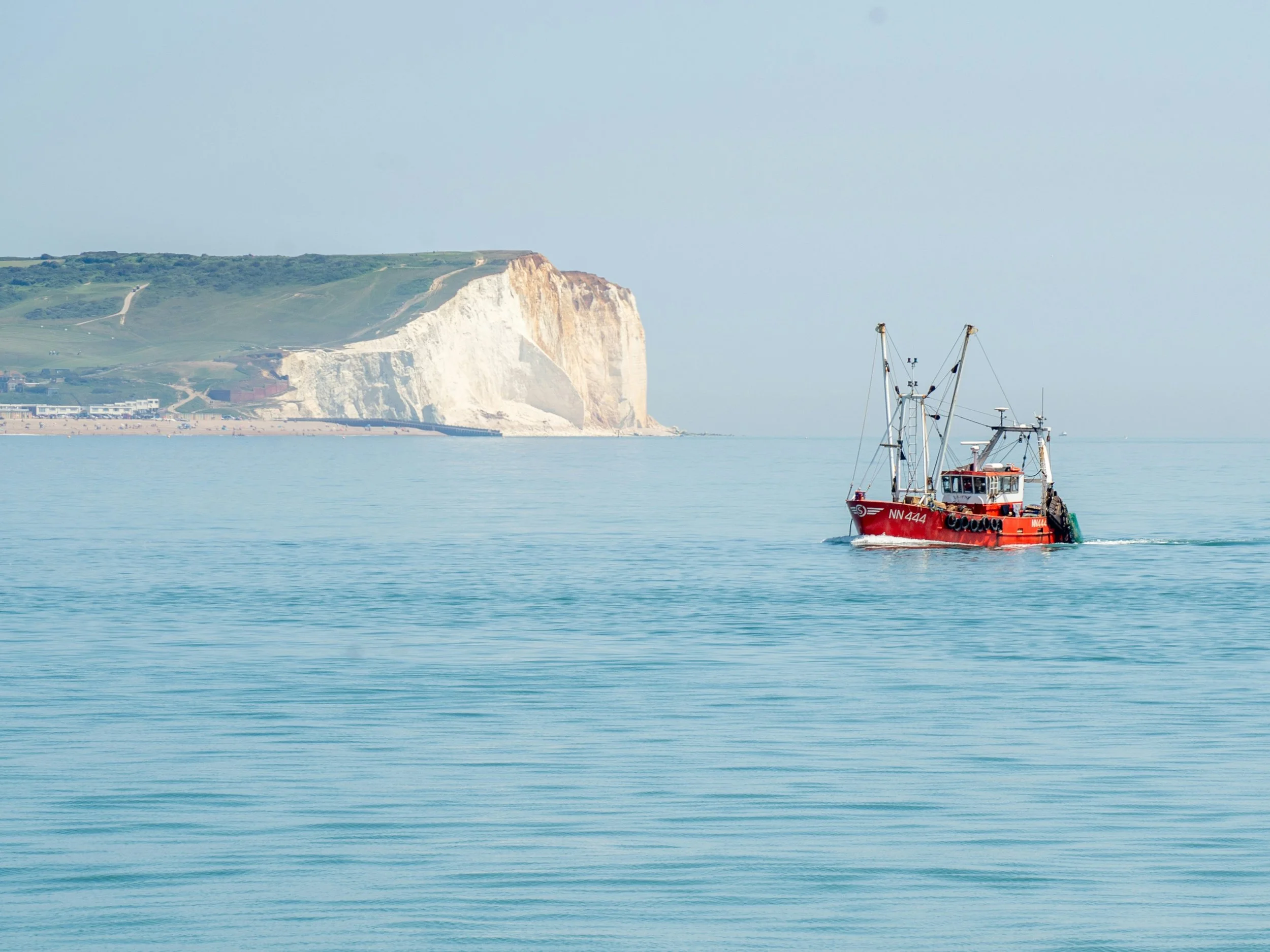
Something is revealing about the way we talk about people crossing the English Channel. Every new arrival produces a new number, a new photograph of an overcrowded dinghy, a new promise to ‘smash the gangs’, and a new policy intended to make the journey harder. The language gets tougher. The patrols get heavier. The boats get bigger. And yet the boats keep coming.
The latest development is almost a perfect illustration of the problem. As enforcement has increased along the northern French coast, smugglers have adapted. Traditional dinghies are being replaced by what have been described as ‘mega-dinghies’, capable of carrying well over a hundred people at once. In July, boats carrying 128 and 165 people crossed the Channel. In August, another carrying around 173 people capsized after its engine caught fire.
The Government points to falling numbers as evidence that its strategy is working. Small-boat arrivals in the first months of 2026 were substantially lower than during the same period last year. But a fall in crossings is not necessarily evidence that the underlying problem has been solved. It may simply be evidence that the people facilitating those crossings have changed their methods.
The history of the Channel route suggests that migration policy has repeatedly produced this kind of displacement. When governments make one route more difficult, people and smugglers find another. Increased security around French ports and the Channel Tunnel helped push people towards small boats in the first place. Increased enforcement on the beaches has encouraged departures from different locations and the use of different vessels. When boats are seized, the business model adapts.
This is not an argument against enforcement. Nor is it an argument for open borders. A state has a legitimate interest in controlling its borders and disrupting criminal organisations that exploit vulnerable people. But there is a difference between controlling a border and pretending that border control can eliminate the reasons people cross it.
The Government's one-in-one-out agreement with France illustrates the problem. Under the scheme, some people who arrive in the UK by small boat can be returned to France in exchange for an equivalent number of asylum seekers being admitted legally to the UK. It is an attempt to make the dangerous journey less attractive. But deterrence only works if the person being deterred has a realistic alternative.
If somebody is fleeing persecution, war or profound insecurity, telling them that the journey is dangerous does not necessarily tell them anything they did not already know. The Channel is not dangerous because politicians have failed to explain the danger. It is dangerous because desperate people are being asked to choose between an intolerable present and an intolerably risky journey.
The evidence suggests that many already understand the risks. Research into Channel crossings has found that prospective migrants are generally aware of the possibility of death, violence and exploitation. Their knowledge of asylum policy, however, varies considerably. And the factors shaping their decisions are often far more significant than the differences between British immigration policies: conflict and instability in countries of origin, family and community connections in Britain, language and cultural ties, and experiences elsewhere in Europe all play a role.
This is where our political debate becomes strangely detached from reality.
We talk about asylum seekers as though they were responding to each new Home Office announcement like consumers to a change in flight prices. Increase the penalty and demand will fall. Make the journey more difficult, and people will stay where they are. Human beings are not quite so economically rational.
The most striking evidence is in who is actually making these journeys. Between 2018 and 2025, nationals of Iran, Afghanistan, Iraq, Eritrea, Albania and Syria accounted for around 65% of small-boat arrivals. These are not interchangeable groups, and their reasons for coming are not identical. Some have extremely high asylum grant rates. Others are overwhelmingly refused. Yet our political language increasingly collapses them into one category: ‘illegal migrants’.
That language does something politically useful. It turns a complicated question about war, persecution, borders, international law and the capacity of the asylum system into a question of whether someone has behaved properly. And once the person becomes the problem, rather than the system through which they are moving, the policy response becomes almost inevitably punitive.
There is another uncomfortable fact that gets lost in the fixation on small boats. Small-boat arrivals represented around 41% of asylum applications in 2025. That means the majority did not arrive by small boat. Around 39% of people applying for asylum that year had entered the UK legally, on work, study, visitor or other visas.
The Channel has become the visual shorthand for Britain's asylum system. But it is not the asylum system. This is essential because we risk designing an entire immigration policy around the most televisual part of a much larger problem.
Britain's asylum system is overwhelmed. Backlogs, delays, inadequate access to legal advice and the costs of accommodation are all real problems. The Government is right to want to disrupt smuggling networks. It is right to want quicker decisions and effective removals where claims are refused. It is right to want international cooperation. But none of those things requires us to pretend that deterrence is a substitute for functioning asylum infrastructure.
And there is a wider question underneath all of this which our political debate rarely wants to ask: why do we assume that migration is something Britain can simply prevent?
We tend to speak about countries from which people are fleeing as though their poverty, instability and conflict are unfortunate conditions that exist somewhere else, to which Britain responds through foreign aid. We give money to developing countries, fund humanitarian programmes and support efforts to strengthen institutions, and then ask why those countries have not solved the problems that supposedly belong to them. There is something deeply uncomfortable about that relationship.
The international order did not simply emerge by accident. Britain, France, the United States and other Global North powers spent centuries shaping it. They colonised territories, extracted resources, reorganised economies around their own interests, drew borders and accumulated wealth and political power through systems that continue to influence the world today. That does not mean every contemporary conflict or economic failure can be attributed to colonialism. Governments in the Global South have agency, and many bear responsibility for the decisions made within their own countries.
But neither can the Global North pretend to be an innocent spectator. We helped construct a global economy in which capital, goods and corporations can move across borders with extraordinary freedom while people face increasingly rigid restrictions on movement. Countries were encouraged, and often compelled, to integrate themselves into global markets, while their citizens were not granted anything approaching the same freedom to participate in the labour markets of the wealthiest states.
“We have become remarkably good at controlling the route while remaining unwilling to confront the reasons for the journey. A border can be policed. A demand for safety cannot.”
And when those inequalities produce movement, we treat the movement itself as the problem.
Even our language of aid can reveal the contradiction. There is something paternalistic in the idea that wealthy countries can transfer money to poorer ones and then wonder why it has not erased decades of economic inequality, political instability or weak institutions. Giving an already fragile state money does not magically undo the structures that made it fragile.
Britain's responsibility does not end at the point where its foreign aid cheque is written. Nor is migration likely to become less significant in the decades ahead. Climate change will displace people. Conflict will displace people. Political repression will displace people. Economic instability will displace people. As environmental pressures intensify in regions already vulnerable to drought, food insecurity and political instability, human movement is likely to become an increasingly important feature of international politics.
We can debate how many people Britain can reasonably accommodate. We can debate how asylum should be administered, who qualifies for protection and how borders should be controlled. Those are legitimate questions. But we cannot sensibly debate them while pretending that migration itself is a temporary policy failure. It is a feature of the world we have built.
And this is where the smugglers matter. It is absolutely right to pursue the criminal networks making enormous profits from people's desperation. In fact, this is one part of the Government's argument that the political left sometimes understates. The people running these operations are not humanitarian actors. They exploit vulnerable people, and their boats are becoming more dangerous precisely because there is money to be made from finding ways around increasingly sophisticated enforcement.
But there is a fundamental difference between attacking the supply of smuggling and eliminating the demand for it. You can seize the boats. You can arrest the smugglers. You can put more police on the beaches. You can make the crossing more dangerous and make the consequences of arriving more severe. But if people still need to leave, somebody will eventually find a way to take their money.
The mega-dinghy is therefore more than a new tactic used by criminal gangs. It is evidence of a system adapting to enforcement. The Government can congratulate itself on fewer crossings. But if fewer boats now carry more people, and those boats are more dangerous, then a statistic alone cannot tell us whether the policy is succeeding. We have reduced the number of opportunities to cross. We have not necessarily reduced the number of people who need somewhere to go.
And the history of Europe's response to migration tells us what happens next. Greece, Italy and Spain have all experienced maritime migration on a vastly larger scale. European governments have responded with bilateral agreements with countries including Turkey, Libya, Tunisia, Mauritania and Egypt. Such agreements may reduce arrivals in particular places at particular times. But they can also displace routes, shift responsibility and push journeys into new and sometimes more dangerous forms.
The Mediterranean offers a warning about what happens when wealthy states attempt to outsource their migration problem. Europe can pay neighbouring states to patrol borders, provide equipment and disrupt smugglers. Britain can pay France to put more officers on French beaches.
Responsibility can be moved geographically but it cannot be made to disappear.
Indeed, there is something deeply circular about the current strategy. We spend more money making the journey harder. The journey becomes harder. Smugglers develop more dangerous ways of making it. The Government points to the dangers created by the smugglers as justification for making the journey harder still. Meanwhile, the people at the centre of the policy remain where they started: needing somewhere safe to go.
That is why the emergence of the mega-dinghy should concern us beyond the immediate horror of seeing 170 people packed onto an unseaworthy vessel. It demonstrates that enforcement changes the market without necessarily eliminating the demand. The smuggling business is not necessarily a single gang that can simply be ‘smashed’. Research suggests these operations often function as loose networks, with different actors responsible for recruitment, equipment and logistics. When one actor disappears, another can fill the gap because the demand remains and the financial incentives are considerable.
So perhaps the question we should be asking is not simply: How do we stop the boats? It is: Why have we built a system in which a boat is the only realistic option for some people who want to ask Britain for protection?
There is no simple answer. Safe and legal routes are not a magic wand either. Evidence suggests that they only substantially reduce irregular crossings when they are available at sufficient scale. A handful of resettlement places cannot absorb a global refugee population. But that is not an argument for doing nothing. It is an argument for admitting that there is no single policy lever capable of solving this.
We need effective border enforcement, functioning asylum processing, international cooperation, serious action against organised exploitation and routes through which people who genuinely need protection can actually seek it. But we also need a more honest conversation about Britain's place in the world. We cannot spend centuries helping to construct an unequal international system, treat the resulting instability as somebody else's problem, and then act surprised when people move through it.
Above all, we need to stop confusing movement with resolution. The number of people arriving may fall. The boats may become larger. The departure points may change. The smugglers may be arrested. France may deploy more police. Britain may sign another agreement. And still, somewhere along the coast, people will be waiting.
That is the part of the crisis our politics struggles to confront. We have become remarkably good at controlling the route while remaining unwilling to confront the reasons for the journey. A border can be policed. A demand for safety cannot.
