

politicians are living in 2005 when it comes to city centres
This week’s In Common focuses on the change in shopping behaviours and its effects on city centres as economic hubs.
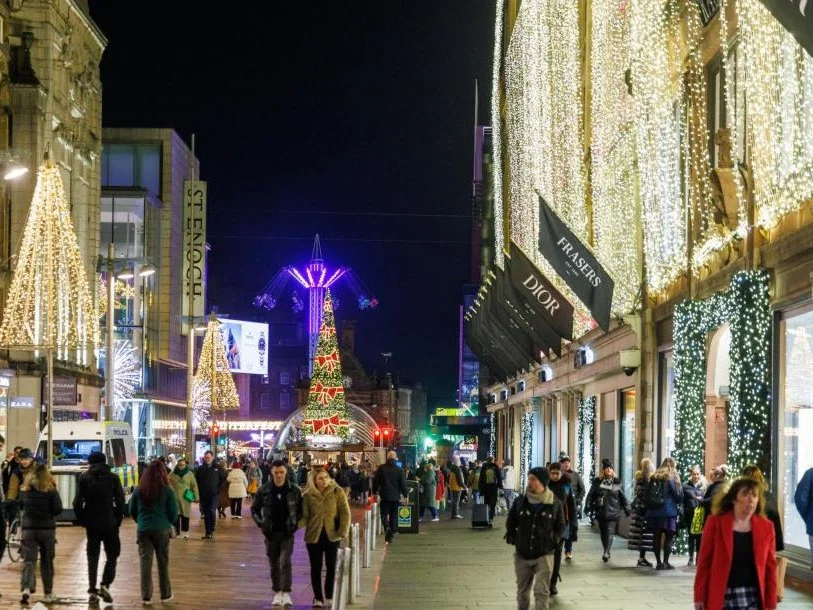
For some of us, the last couple of weeks have been spent at home: running errands, tidying up neglected corners of the house, seeing family and friends, briefly unshackled from work. For others, it has been business as usual. Hospitals don’t close for Christmas, nor do buses, care homes, call centres, shops or hospitality venues.
For those working in retail, one thing has been impossible to ignore: the crowds just aren’t what they used to be.
It is no secret that the high street has been struggling for years. But over the festive period, the question felt sharper than usual. Is this no longer just a high-street problem? Are city centres themselves beginning to hollow out in the same way?
The simplest explanation is also the most obvious. People have less money. Food costs more. Rent and mortgages cost more. Transport costs more. Energy costs more. When household budgets tighten, discretionary spending is the first thing to go. Christmas becomes more anxious, more cautious, more tightly planned. Fewer impulse purchases. Fewer ‘we’ll just see what’s about’. Less money overall is changing hands.
But that is only part of the story.
What matters just as much is not how much people are spending, but how they are spending it. Even where money is being spent, it is increasingly happening elsewhere. Online retail continues to absorb a growing share of consumer spending, and the logic is hard to dispute. When money is tight, people don’t wander. They plan. And planned purchases overwhelmingly favour online platforms over physical shops.
This is why some of the recent data appear contradictory at first glance. While many retailers report weak footfall across the Christmas period, Boxing Day told a more complicated story. Overall, visits were lower earlier in the day, but rose sharply in the evening as the shops stayed open later. People did come out – but they spent less.
That distinction matters. Footfall and spending are no longer moving in tandem. Being physically present in a city centre does not mean engaging in consumption in the way our economic models still assume. People increasingly treat town centres as places to pass through, to meet, or to eat – not necessarily to buy.
And yet our political response remains stuck in a different era.
For years, governments have acted as though the problem facing the high streets and city centres is a lack of vibrancy, rather than a lack of money. The solution offered is almost always aesthetic: regeneration projects, rebranding exercises, public realm improvements, and pop-up events. As though footfall alone were the measure of economic health.
But footfall without spending does not pay wages. It does not keep shops open. It does not sustain local economies.
What we are seeing instead is the collision between the consumption-based economy and a population that can no longer afford to consume in the way that the economy requires. We are still organised around retail-led city centres, even as the conditions that made them viable are quietly disappearing.
This is not a moral failing on the part of the shoppers. It is a rational response to insecurity. People are adapting faster than the systems built around them.
And that creates a political problem. Because city centres were never just places for commerce. They were a social infrastructure. They were where people worked, met, spent time, and felt part of something shared. As retail drains out, what replaces it?
Too often, the answer is nothing.
Empty units become normalised. Temporary fixes stand in for long-term planning. We are told that this is simply ‘the market adjusting,’ as though markets were natural forces rather than political constructions shaped by tax policy, planning law, transport investment and labour conditions.
The danger is that we accept decline as inevitable rather than interrogating what kind of economy we are choosing to sustain. If consumption is increasingly online, then what are city centres for? If spending power continues to be squeezed, who are they designed to serve?
There is an opportunity here, but only if we are honest about the problem. Reviving city centres cannot mean pretending it is still 2005. It cannot rely on encouraging people to spend money they do not have. It requires a shift away from retail as the organising principle of urban life, and towards housing, public services, culture, care, education, and genuinely shared spaces.
That kind of transition requires political will – and public investment. It also requires abandoning the comforting fiction that the problem can be solved by better branding, later opening hours, or other regeneration strategies with no economic backbone.
What retail workers are seeing on the ground is not just a bad Christmas. It is a system showing its limits. People haven’t stopped leaving the house. They haven’t stopped caring about their communities. They have stopped participating in an economy that no longer works for them.
The question is whether politics is prepared to notice – and respond accordingly.
