

I’m over the moon
Henry Mathias traces the shift from Apollo’s Cold War spectacle to Artemis’s new lunar ambitions, exploring the politics, power and narratives behind the race back to the Moon.
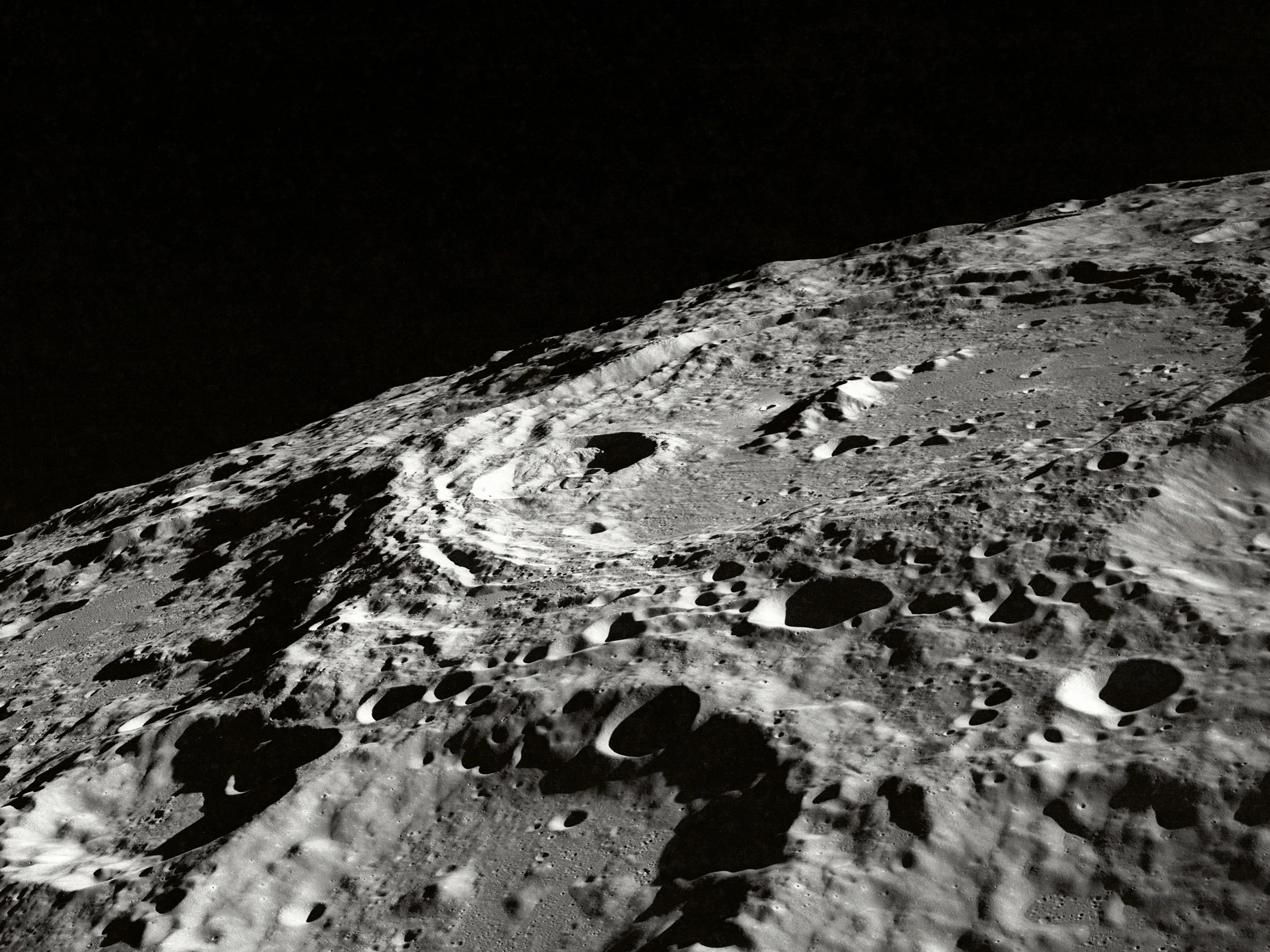
Reading Craig’s article on Artemis, I couldn’t help but react. Is the Artemis program really such a benign counter to the hostile North American narrative inundating us just now? After emailing Common Weal, I was pleasantly surprised to be asked to respond by way of an article. So I delved a bit deeper, and here we are.
The Moon landing sold the American dream far better than watching all those cowboy films and wanting the indians to win. As a child, I think it was Star Trek and 2001: A Space Odyssey that then sealed the deal for me, cementing a deep emotional connection with the US, space, and the belief that a new world was possible. What was launched from Florida, whether by NASA or Disney, sure captivated this boy from England. A lovely bubble to be born into.
Looking back, it turns out Apollo was all about winning hearts, minds, and the Cold War rather than Teflon or any humanitarian mission. And now NASA’s in another lunar race, this time neck-and-neck with China for the South Pole, closely followed by India and Russia. Except this time, NASA’s role seems to involve merely preparing the ground for the main event to come, with Trump announcing a 23% budget cut to the state space agency as Artemis II orbited. The main event is colonising and then extracting the Moon’s helium and water resources by Musk’s SpaceX and Bezos’s Blue Origin.
When I first heard about this, I thought science fiction or conspiracy, until reading about the Artemis Accords brought me down to earth with a jolt. The 2020 Artemis Accords ride roughshod over the 1967 Outer Space Treaty and give the US extraction rights to the Moon, Mars, and other astronomical objects under international law. To date, 61 countries are on board, with the UK an early signatory and the rest of Europe following suit.
Unsurprisingly, China and Russia have their own version, which sets out plans for China’s National Space Administration and Russia’s Roscosmos to jointly construct an International Lunar Research Station on the South Pole by the 2030s. Apparently, the superpowers are all racing to the South Pole because there lies the Moon’s largest and deepest crater, giving the best access to the resources below. A literal waste of space.
I was already familiar with ‘Artemis’ as the name of a venture capital fund, which advertises itself all over Edinburgh in the form of a profit graph dressed up as a pterodactyl: The Profit Hunter. Fittingly, Artemis is the Greek goddess of hunting as well as the moon.
Apparently, the Artemis II launch reached an audience of 18 million on NASA’s YouTube channel. No doubt there was also a big online audience for China’s Chang’e 6 mission to the South Pole in 2024 (named after the Chinese goddess of the Moon) to extract samples from the far side of the Moon for the first time. And presumably the Chinese audience was fed a similarly uplifting narrative about Chang’e 6’s mission on behalf of humanity and world peace.
Just as Artemis II coverage chose not to dwell on the lunar debris from previous Russian, Chinese, and Indian lunar missions, so Chang’e 6 is unlikely to have majored on the 178 tonnes of Apollo waste, including six spacecraft, three lunar rovers, six flags, and five plaques. The most famous plaque says, “Here men from the planet Earth first set foot upon the moon, July 1969 A.D. We came in peace for all mankind”.
Even as I write this, I’m feeling like a party pooper. Scotland’s historic relationship with Florida goes deep; the ongoing love affair with Cape Canaveral is palpable from the amount of NASA merchandise I see worn across the central belt every day. And who on earth would criticise the beatific Professor Brian Cox, the face of pure scientific goodness in the running to don Attenborough’s halo? Given the Earth’s finite resources, the climate and nature emergencies, the whole Artemis program might make sense. Far from being a counsel of despair for future generations, mining the Moon and using it as a base camp for occupying Mars might be a wise insurance policy for us all.
Cynics like me who dish Artemis as a castle-in-the-air, a dangerous diversion from achieving peace on Earth in order to save the planet, are maybe stuck in the past. After all, we already have a strong track record of transforming deserts into paradise, through the wonders of air conditioning, desalination, and very controlled migration. Saudi Arabia and the UAE, major investors in Artemis, show us what humans can create on a blank canvas, with sufficient science and resources. Moving to Mars could be just the ticket.
I guess the final frontier is where we project our hopes and fears, and I’m no different in that. Smoke and mirrors work on multiple planes. Lots of smoke for the launches and plenty of mirrors deployed on the missions. And whichever side you’re on, whatever your superpower, we probably all suspect that most of the Artemis and Chang’e coverage is a masquerade for the real race to achieve military and technological domination over each other.