

Through with drive-throughs?
COVID lockdowns put drive-throughs in pole position, and the UK is now experiencing a tsunami of expansion, with community volunteers left with the resulting tides of litter. Given such minimal retail space and cleaning costs, drive-throughs are clearly very good for business, now accounting for 70% of McDonalds’ income and more and more brands taking to the road. But just how bad are they for our children and communities? Guest writer Henry Mathias explores.
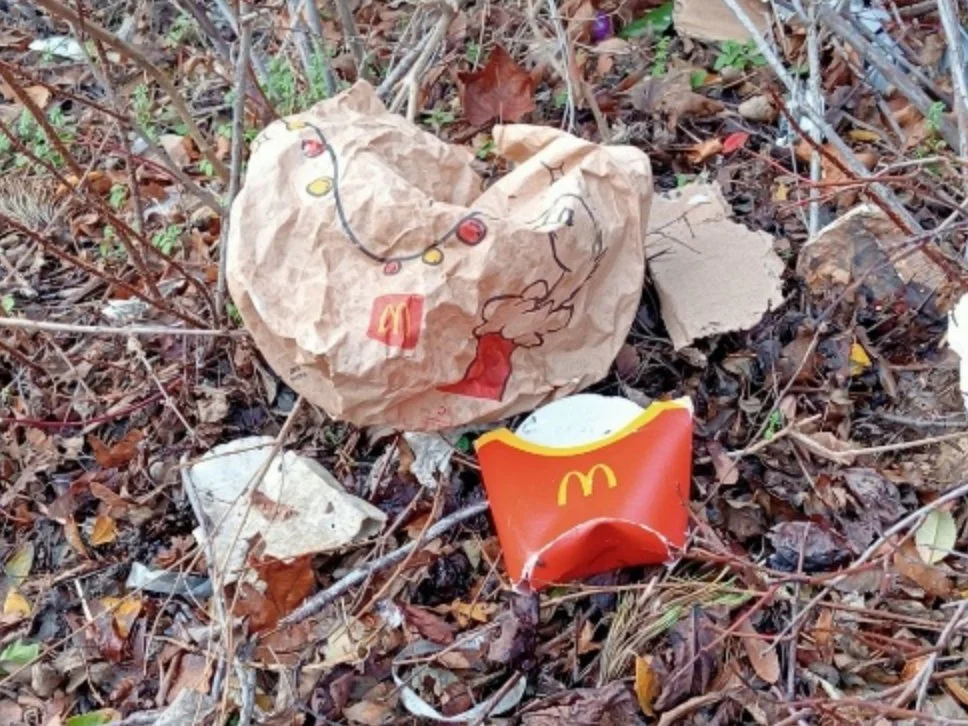
Image Credit: Tranent Wombles
I’m chair of a volunteer litterpicking group, Tranent Wombles, and every time a drive-through opens within a 15-mile radius, we know all about it. An increasing proportion of the 1,000-plus bin bags we pick up yearly comes from drive-throughs. Ultimate responsibility, of course, lies with consumers, but drive-throughs as a retail model seem inherently prone to littering.
The UK was already unable to cope with littering from traditional outlets, then along came Covid and lockdown, turbocharging the growth of drive-throughs. Their growth is also fuelled by the rising number of van drivers out there rushing around with our online shopping and home takeaways delivered from drive-throughs.
If you’re eating food with your hands in a clean car, I guess it is tempting to just chuck it, especially when you know there won’t be consequences.
So here I am in Haddington in front of the Planning Committee of East Lothian Council, trying to persuade them to refuse permission for the latest drive-through, this one another 24-hour McDonalds just off the A1 at Macmerry. If we know that drive-throughs result in disproportionate amounts of litter, is it not irresponsible to just continue to license them? At what point do we start saying no?
Despite objections from local litterpicking groups and Community Councils, it’s no surprise that planning approval is duly given by East Lothian Council. Authorities in the UK are reluctant to refuse planning applications for new businesses or use the levers at their disposal to reduce littering. For example, in 2024, Elizabeth Wright gathered over 60,000 signatures for a petition to require all drive-throughs to print car registration numbers on packaging, with the UK Government’s Department for Environment, Food and Rural Affairs responding:
"We do not think it would be cost-effective to require takeaway food vendors to implement a vehicle registration number printing and tracing system for packaging… This is due to the additional burden it would place on these businesses and those involved in enforcement."
Two years earlier, the Welsh Government, in response to public pressure, met McDonalds about car registrations being printed on packaging or receipts, but backed off taking action. If litterpicking groups could report registration numbers on packaging we find, we think it would only take a few well-publicised convictions to make a big difference. Persistent inaction on car registrations seems to say more about the collective will than the way.
Littering from cars has clearly become habitual, with 35% of drivers owning up in a survey by Leasing Options, but so has society’s inability to do anything about it. The UK has more CCTV per capita than any other country bar China and the US, but again, we are deciding against deploying technology to reduce this criminal activity. In Australia, CCTV footage (including from dashcams) automatically results in a hefty fine and three points on your license.
Many of us are just back from holidays in countries with loads less litter. The comedian David Sedaris is serious when he says the UK has the worst litter problem in the developed world, and I think this reflects bad governance just as much as all those bad people amongst us. One of the levers other countries pull is enforcement.
So, I thought I’d find out about our current levels of prosecution and contacted the responsible national agencies. It turns out that Keep Scotland Beautiful, Zero Waste Scotland, Scottish Government no longer even keep track. I had to resort to Freedom of Information legislation to discover that in the average year, my local authority issues just one Fixed Penalty Notice for littering and x1 for flytipping. There’s clearly no appetite for using the stick approach.
From McLibel to McStrike
As a campaigner for the rights of children and the environment, my (100% pure) beef with the McDonald’s drive-through goes way beyond litter, of course. After growing up with the McLibel trial and Fast Food Nation, I naively assume everyone must know just how unhealthy it is to eat McDonald’s. The McLibel Trial remains the UK’s longest court case after McDonald’s decided to sue activists Helen Steel and Dave Morris for a pamphlet calling out the corporation.
As detailed evidence came out in court (with a radical hotshot lawyer by the name of Keir Starmer giving the activists pro bono support), McDonald’s aggressive legal action backfired spectacularly. The McLibel Trial exposed McDonald’s marketing practices targeting children and how that special relationship with our children had been, as it continues to be, cultivated.
Happy Meals in the 1970s were credited with revolutionalising how children engage with fast food, with a wicked combination of toys and taste buds. Presumably, McDonald’s chooses to spend so much on saturation level advertising in our poorest communities and freebie learning resources for schools for good reason.
At the Planning Committee, there was much talk of young people benefitting from the jobs being created at the new drive-through and praise for McDonald’s Hamburger University. I stuck to litter and didn’t mention the company’s surveillance of UK unions fighting for McDonald’s to allow union recognition. Or the BBC investigation of over 100 complaints from McDonald’s staff about a culture of harassment and sexual abuse.
The 2023 investigation made it safe for more complainants to come forward, with over 700 staff now taking legal action and 450 restaurants implicated. It’s serious enough for Westminster’s Business and Trade Committee to have required the McDonald’s UK boss to give evidence and for the Equalities and Human Rights Commission to set up a dedicated helpline for McDonald’s staff. Meanwhile, back home in the US, drive-thrus are replacing humans with AI for the job of taking orders from customers. And apparently, the remaining staff are loving it.
Drive-throughs in pole position
While the quality of drive-through jobs can be debated, there’s no doubting the real beneficiaries from this cash cow. With minimal retail space and cleaning costs, it’s unsurprising that drive-throughs now account for 70% of McDonald’s overall income and that more and more brands are taking to the road. Back in 2020, the NPD Group reported the 2,200 UK drive-throughs generating over £3 billion annual income. Now there’s 2,681, and they’re growing exponentially.
According to the NPD Group: “As we face a new way of living, with perhaps more time in our cars and a greater reliance on online and digital ordering, it makes sense for operators to invest in drive-thru, and we expect to see it expand beyond coffee and burgers to pizza, Indian, vegan and other cuisines.”
And if you drive North from the UK’s affluent South, you’ll find more drive-throughs. In 2024 research by Moneybarn found London had a density of 1.29 drive-throughs per 100,000 people, which compared to Glasgow’s supersized 8.62.
Our love-in with drive-throughs also reflects and embeds a culture based on the private motor car. On a crowded island, with more than a fifth of us not owning a car, this feels like we’re emulating a lifestyle from another continent and a previous era. And guess what? Drive-throughs won’t serve you if you turn up on a bike, motorised or not.
Pushing back
As a community litterpicking group, Tranent Wombles objecting to the latest drive-through and standing in the way of economic development feels like a lonely and lost cause. But researching this article gives me hope that we’re part of a bigger push back. According to the American Planning Association, full or partial bans of drive-throughs have been introduced in more than two dozen Canadian cities, including Vancouver, Calgary, and Toronto.
In the US, Minneapolis recently imposed a ban across a district of over 400,000 residents due to concerns about vehicle emissions, litter and the dangers to cyclists and pedestrians rather than healthy eating. In the UK, many local authorities, including Glasgow, Brighton, Hull and Sheffield, have started refusing planning applications for drive-throughs. Most notably, after Gateshead effectively banned any new fast-food outlets in 2015, they found this reduced childhood obesity in areas with the highest concentration of fast-food premises.
What buoys me up the most, however, is campaigning by the youth-led charity Bite Back, which counters the influence of fast-food brands with their all too successful marketing aimed at poorer neighbourhoods and young people. There’s a lot currently stacked in favour of more and more drive-throughs opening. In addition to all the economic drivers, they also sell tasty products and are very popular. So, if we’re going to turn the tide on their planned roll-out, it’ll take a concerted effort. With young people leading the way, we’ve maybe started heading in the right direction.
********
For more pieces by Henry: https://substack.com/@henrymathias