

The SNP aren’t making the most of a golden opportunity
This week’s In Common by Rory Hamilton explores shifting global power and the growing volatility of US policy, and how this relates to Scotland’s independence in terms of financial, energy, and strategic sovereignty.
As global politics is reshaped in the image of Donald Trump, Scotland is being left behind in yesterday’s politics. This week’s attack on Iran was an illegal act of war undoubtedly, but moreover it appears reckless and lacking strategic foresight.
This is no clearer than in Trump’s response to its NATO allies in the days after, with petulant jabs at Keir Starmer for not jumping on the war crimes bandwagon this time around, and also at Spain’s Pedro Sanchez who denied the US use of Spanish air bases – resulting in a kneejerk reaction declaring the ceasing of all trade with Spain.
But it is not just Trump’s erratic and unpredictable foreign policy that has accelerated a "decoupling" from the US, as much as it might be a catalyst.
Firstly, the weaponisation of the global financial system and the use of trade tariffs is leading to a drift away from the dollar as a global reserve currency, and even more so as it becomes a coercive tool of US foreign policy.
Secondly, there is also a European reliance on US payment systems, which, again, can be weaponised (such as the International Criminal Court prosecutors who have been sanctioned by the US such that they are blocked from using these payment systems). The same goes for Swift, which is an interbank payment system that accounts for 50% of the world’s cross-border currency transactions, but that the EU is seeking to diversify from in order to avoid being blocked from global financial markets.
Thirdly, and perhaps most pressingly, in light of potential economic shocks reverberating from the closure of the Strait of Hormuz and the exporting of oil from the Middle East, the Scottish Government’s persistent resistance to publicly-owned energy, despite our ability to meet our needs through our abundant renewable resources. Instead, we would rather US-based hedge funds buy up both the ScotWind estate and Scotland’s land portfolio.
All of this makes the context of the independence debate seem small. We haven’t moved on, and we’re still stuck in this cycle of dangling the "mandate" election in front of the electorate’s noses without relating the cause of independence to current global and domestic challenges.
By failing to make this link, the SNP makes the independence debate an unserious parochial discourse.
Even then, key questions around currency, borders, and defence are stuck in 2014 (which even then was never adequately enough answered to win). Common Weal proposed a way for Scotland to set up its own payments system a number of years ago – to unreceptive SNP ears – and Peter Ryan has reiterated this in The National again this week.
The SNP’s currency plans are still based on using the pound and reliant on the Bank of England – deeply unserious to be relying on another sovereign state to dictate your monetary policy in this geopolitical climate.
Furthermore, as Common Weal has reiterated many a time, the SNP is wedded to foreign-direct investment as an economy strategy, supposedly leveraging in essential investment and supply chain opportunities for the energy sector, when in reality it merely produces profits for often publicly-owned foreign energy companies and so far very little in the way of supply chain benefits for workers and SMEs in Scotland.
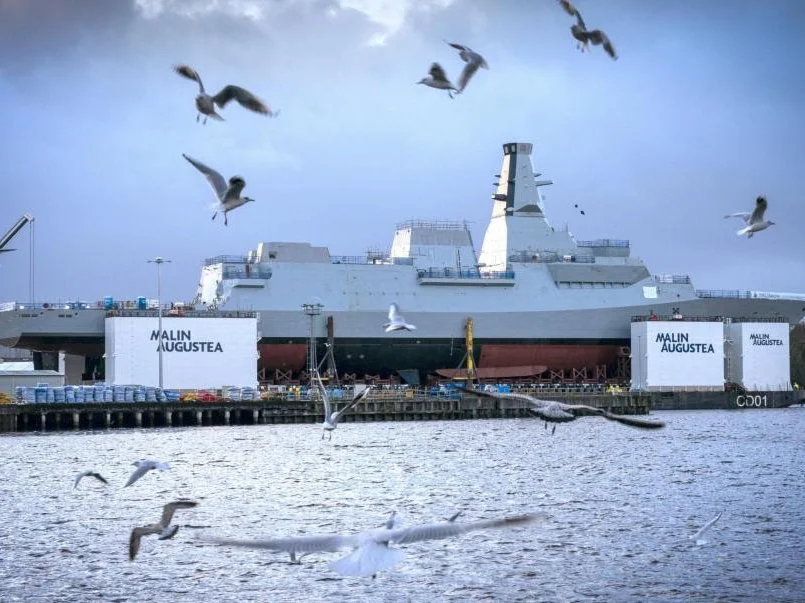
This shouldn’t be used to distract from Scotland’s role in the global arms trade, as we host BAE Systems (below) and Thales in Govan, Babcock in Fife, Leonardo in Edinburgh. And as little as a month ago, the Scottish Government was aiding and abetting the US seizure of the Marenera oil tanker and the refuelling of US planes in Scottish airbases.
The SNP has not been shied away developing an international development strategy either, with outposts in the US, Canada, France, China, Germany, among others. So we cannot pretend that acting like a state before independence is beyond comprehension.
If we wish to be taken seriously in global affairs, we should carve out a role for ourselves now at this crucial moment. And it is important that we do, as people look for leadership in chaotic times like these. Moreover, they need a way to relate their beliefs to the events happening around them as they look for a way to understand the world a contribute to its wellbeing.
Unfortunately, it feels like leadership for Scotland is currently lacking. What all this tells us that the SNP’s vision for an independent Scotland in the world is at best incoherent, and at worst piecemeal and arbitrary. If independence is about sovereignty, then we can start by disentangling ourselves from US-led financial, technological and military systems that take power away from ordinary citizens to shape their lives.
