

It’s a lack of will, not consensus, that prevents Council Tax reform
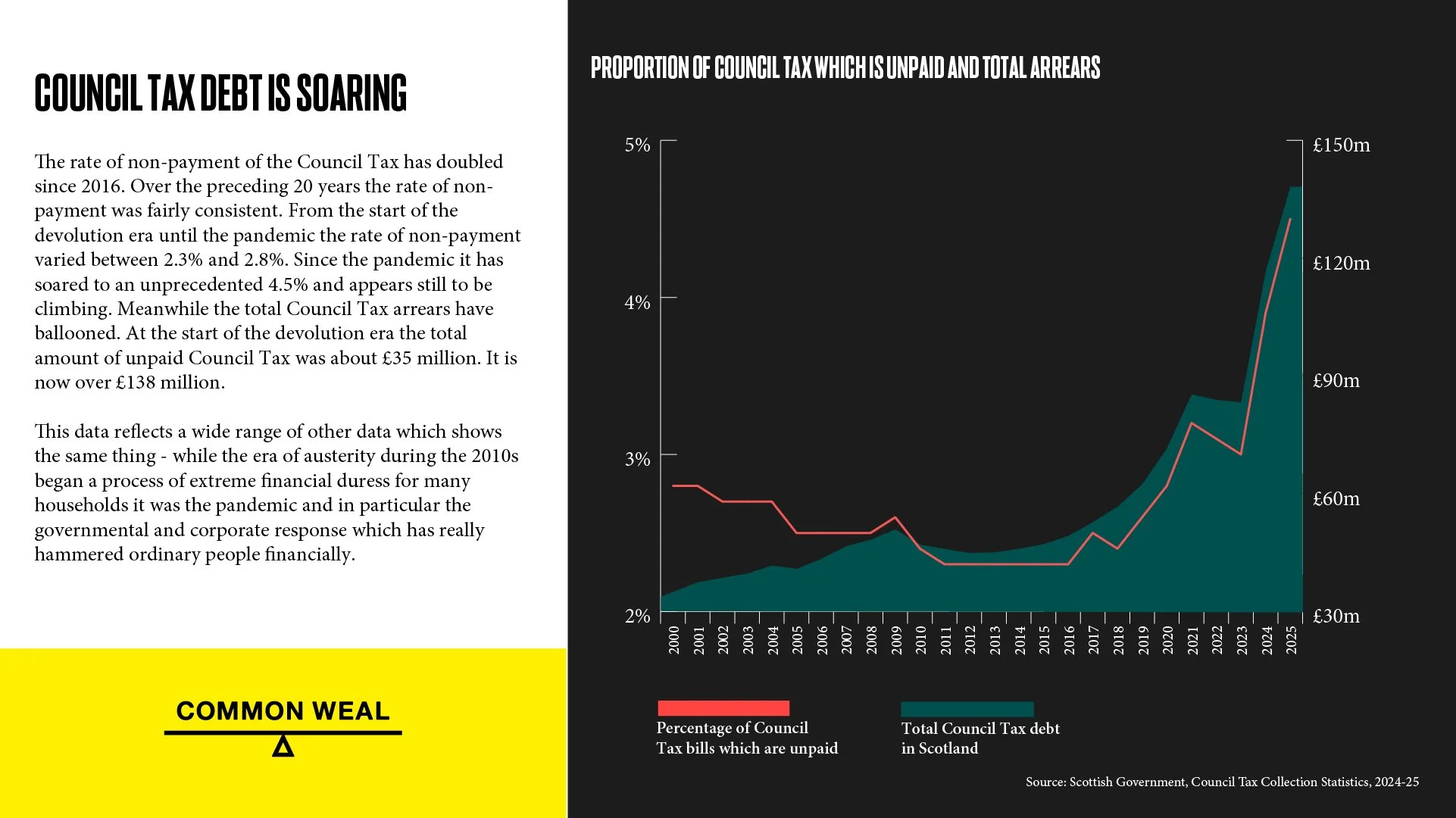
The Scottish Government’s failure to reform Council Tax has gone on far too long. It must be a defining mission of the next Parliament to reform it in the only fair way possible.

The Joseph Rowntree Foundation has published a significant intervention into the upcoming Scottish election, saying that the next Parliament must stop cringing away from reforming Council Tax.
The Scottish Government’s current position is that they can’t make that change because there’s no political consensus for what comes next. This is a disingenuous take, given the chances they’ve squandered or deliberately suppressed in order to manufacture that situation.
Everyone, even the Scottish Government, agrees that the Council Tax is fatally broken. No other tax is based on valuations that were set a third of a century ago (imagine suggesting that your income tax should be based on what your salary was in 1991). No other tax so badly misvalues so many houses (imagine there was a 50:50 chance that your income tax code wasn’t even based on the job your doing right now). Almost not other tax gives such a high tax break to so few at the expense of so many. It absolutely must change and should have changed 30 years ago.
There have been several alternatives to the Council Tax that have been mooted over the years. Some have been better than others. But to my mind at this point there really are only two possible positions in the debate.
On one side, there are those who advocate for a fair and proportionate Property Tax that applies the tax based on a percentage of the present value of a home. Our own proposal to this effect models – for the purposes of making the argument – a flat percentage rate across all homes but there’s absolutely no reason why that rate can’t be varied by Local Authorities, surcharges for multiple ownership or even, as our friends at Future Economy Scotland have mooted this week, why there couldn’t be a progressive element for very high value homes.
The key point to this though is that if your neighbour who differs from you only in that they own a house that costs ten times as much as yours does, then it is fair and just that they pay ten times as much Property Tax than you do.
On the other side of the argument there is everyone else – who, regardless of what they are putting forward in terms of a reform plan – fundamentally believe that the top 10% of property owners in Scotland should have their lifestyles subsidised by the rest of us - even those of us who are going increasingly into debt just trying to keep a roof over our heads.
That sounds harsh, but let me explain.
If you believe in a banded Council Tax similar to the current one or perhaps modified by the proposals in the recent Scottish Government consultation (or their plan for a mansion tax that came out of nowhere while that consultation was still live) then houses in the top band will always and by definition win a tax cut. Even under the “mansion tax” proposal, a £20 million house will pay the same Council Tax as a £2 million house. This is not fair.
Under our proportionate Property Tax and even under its nation-wide flat rate of 0.63% (or £630 per year on a £100,000 house) we found that despite bringing in the same amount of total revenue, almost everyone whose house cost less than £400,000 would get a tax cut. The same would also be true if any of the Government’s consultation options were adopted and then we decided to move to out Property Tax later. The banded system simply doesn’t work and ALWAYS leads to a subsidy for the rich.

The same is also true for replacing Council Tax with an income tax (a position the SNP had in 2007 and some other parties still have). Wealth inequality is far higher than income inequality and property speculation is itself a major driver of that wealth inequality. Failing to tax wealth would release the brakes even further on property speculation and allow those who bought houses when they were cheap to profit even more when they sell them (The myth of the aged widow with no income living alone in their mansion with no-where else to go is largely that and would be better solved with individual discounts or exemptions and providing more appropriate housing they could move to).
But if, after that, the political parties still can’t agree to reform Council Tax in the only way they should then they should have stopped being the problem. In the run up to the 2021 election, the SNP made a manifesto promise to hold a Citizens Assembly on local tax reform, including Council Tax reform. They failed to deliver on that promise. That Assembly could have created the consensus that Robison is using as a shield against inaction – which is probably why they failed to deliver.
As I point out when I wrote about this last time, the major weakness of the idea of a Citizens Assembly is that politicians fundamentally don’t want them to work. For them to work, the politician has to step out of the way. They have to accept that the Assembly is happening because they weren’t able to do their job. They have to give the power to make the decision to the citizens who form the assembly and then they have to agree – ahead of time and not just if the final answer suits them – to carry out the instructions given to them by the Assembly.
If Shona Robison or her successor wishes to claim that the reason they can’t reform Council Tax is because of a lack of consensus then it is incumbent on them to create that consensus. If they can’t do it themselves, then they need to accept that they are part of the cause of that lack of consensus and should step out of the way.
The debate on Council Tax reform has gone on far too long. Everyone agrees that things need to change. No-one, it appears, wants to be the one to take the responsibility of making that change happen. This isn’t good enough. I’ll be watching the party manifestos closely in the coming weeks. If any of my local candidates can’t tell me what their party is going to do about this failure of responsibility that leads to 90% of people in Scotland effectively subsidising the top 10%, then I’m going to have to ask them who I should vote for instead of them.
