

This week’s article in In Common was written by Hazel Mackie and Michael Maciocia from the “Say No To Larbert Data Centre” campaign.
Throughout 2025 and the early part of 2026, Civil Servants allowed themselves to meet, and be influenced by, a company with no track record on the build, deployment or maintenance of hyperscale AI data centres.
This company, in it’s own public admissions, being in the business of purchasing parcels of land, obtaining planning consents on the land and selling on. So, why did such a company have it’s vision briefed to the First Minister of Scotland? Why has this company then been celebrated as some type of visionary in interviews on the BBC, STV, newspapers like the Scotsman, Herald?
The company is called Apatura. They have never built a hyperscale AI data centre anywhere. They have never operated a hyperscale AI data centre anywhere. In fact they have never built or operated a data centre anywhere. So, why the statement on data centres and hyperscale AI data centres? Apatura would have you believe that one is simply an extension of the other. In fact, the Cosla-owned Improvement Service allowed Apatura to train 200 of Scotland’s local authority Planning Officers on exactly this.
Hyperscale AI data centres are not extensions of traditional data centres where banking, social-media, on-line news, shopping are done. They are about inference. The creators of the largest models in the US, warn that they are going to make mass unemployment happen.
This supported by the Open University report on 450,000 jobs being either adversely impacted (read wage cuts) or eliminated with the arrival of AI, in particular agentic AI that the clamour to build in Scotland is currently about.
Let us be clear; agentic AI is about job displacement – Musk, Gates, Anthropic, OpenAI, Meta and Google have told us so. The agents displacing these jobs will not pay income tax, council tax or excise duty and nor will they spend in local businesses.
Freedom of Information requests to organisations has revealed a load of information. One example is a research paper about hyperscale AI data centres paid for by the public purse and commissioned by Scottish Enterprise from the Frazer Nash consultancy.
It was started in January 2026 and published in May 2026 and told of limited economic benefit to Scotland beyond the build, the danger to the grid and the negative impact on the overall ability of Scotland to build things more beneficial to the Scottish economy and academia. Information available and shared within Scottish Government departments.
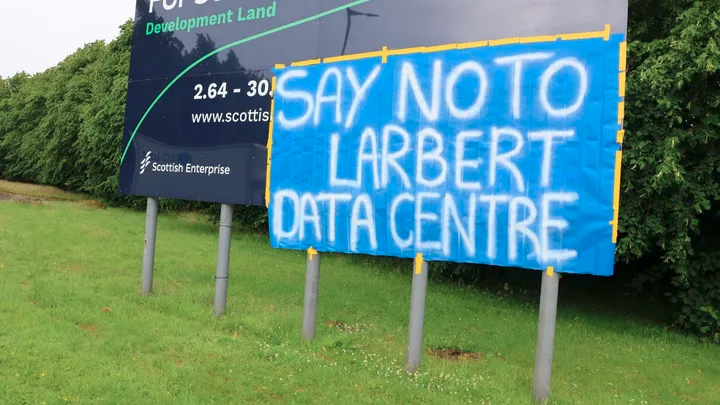
In June of 2026, Apatura lodged a planning application with Falkirk Council for a 300 megawatt hyperscale AI data centre at Glenbervie in Larbert. The site directly neighbours homes, businesses and, most importantly, a 56 bed care home for terminally ill, disabled people and folk recovering from intensive care hospital stays.
The proposal has 200 diesel generators and some of these will sit about 20 metres from the care home. The buildings are 25 metres high, the exhaust flumes from the generators 28 metres high. In addition to the care home, the Forth Valley Royal Hospital is under 500 metres from the proposed development and its generators.
This hospital has 860 in-patient beds, a maternity unit and serves over 300,000 people in the Falkirk, Stirling and Clackmannanshire council areas. The proposed site is on the emergency route from Stirling and Clackmannanshire to the hospital; construction and operation traffic would share the same road access.
The freedom of information documents, show civil servants congratulating Apatura on their application. Not one expressed concern on the siting and proximity to so many vulnerable people. Instead, these same civil servants promoted a “Green Data Centre” vision in briefing documents – a term Apatura had used extensively in their lobbying.
Every local and regional MSP bar Amanda Bland and Mark Griffin, have come out strongly condemning the Larbert plan as being the wrong plan in the wrong place. The local MP, Brian Leishman, has raised the issue in the UK Parliament. Noticeably absent? The MSP for Stirling, Alyn Smith.
The Scottish Government has said it will produce planning guidelines to offer some protections to communities affected. The campaigning groups around Scotland wrote to Hannah Mary Goodlad asking to meet with her to discuss what needed to be included in this guidance . She refused.
In the refusal to meet with us there was a response from the very group of civil servants that are promoting the things we are opposed to. Their comment was “Hyperscale Data Centres provide the physical infrastructure supporting digital activities such as cloud computing, artificial intelligence (AI), telecommunications, financial services, public services, ecommerce and internet applications”.
This shows either the depth of their misunderstanding of the issue, or it is a deliberate misdirection from the Scottish Government. This misinformation is why they need to talk with campaigning groups like our group in Larbert.
We are regularly accused of being Nimby’s, of not understanding technology, of being anti-light bulb. The truth is that the campaigning groups in Scotland are made up of people with technology backgrounds, people who worked in AI, scientists of computer technology as well as ordinary, deeply concerned citizens.
We are not anti-technology. We are for the right technology, owned and developed in Scotland in the right way, delivering for Scotland and the communities within it. What we do oppose is yet again handing over our industrial policy to foreign interests which bring no benefit ti us.
These data centres are no more Scottish than the wind blowing elsewhere in the world.
“Whatever it is, the way you tell your story online can make all the difference.”