

Borders are easy – but not necessarily simple
As Common Weal crowdfunds for our Prospectus for a New State, Craig examines one part of it to give a taste of what is to come.
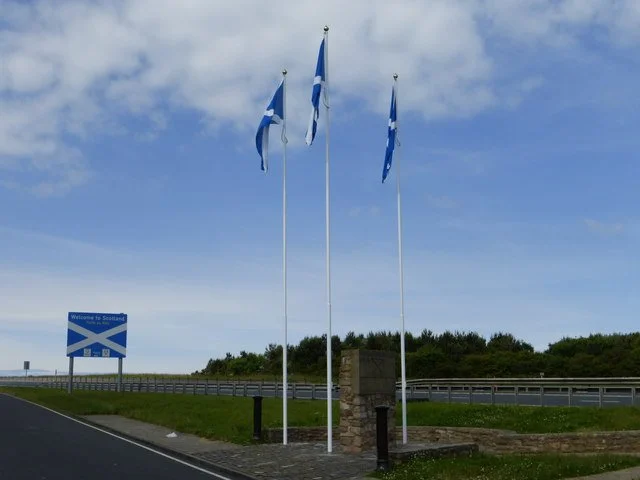
Image Source: Wikimedia
In our initial promo for our new project – A Prospectus for a New State – we made quite possibly a controversial statement.
In describing the outline of the Prospectus and the kinds of areas it will cover as we lay out the institutions Scotland will need to set up between the point of an independence referendum and Independence Day, we said that compared to some of the other topics “borders are easy”.
It’s worth exploring what we meant by that. We’re not saying that building up the infrastructure to manage Scotland’s independent borders will be easy. We’re saying that the choice whether or not to do so is easy. It’s barely a choice at all.
In How to State a New Country, we laid out the process of becoming an independent country in a linear narrative form, taking the timeline of events that need to happen to show that the whole process should be bound not by arbitrary deadlines (like the “18 months” promised by the Scottish Government in 2014) but by how long it would reasonably take to set up the essentials (for example, we thought that the fastest reasonable time it would take to set up a new currency and the banking infrastructure required to manage it would take about three years).
In this new Prospectus, we’re taking a more project management approach. Each of the tasks we identify (we’ve identified around 80 at the moment) will be split according to various degrees of sovereignty that Scotland will have over the process.
Some we’ve deemed “essential”, as in there is only one clear option and that an independent Scotland must do it. An independent Scotland must have a borders and customs office of some description. It’s an “easy” choice to make that we should do this, because it’s not really a choice at all. It will also be an “easy” task to work out what kinds of job that office will perform and how it could perform them as there are modern international standards that Scotland obviously should abide by. “Should Scotland set up a borders agency?” is an “easy” question – yes we should.
“An independent Scotland will have fully sovereign control over our borders, but there are equally sovereign countries on the other side of those borders too.”
Slightly more complicated are our “options”. When it comes to borders, this is about how that office should be run. Currently, borders and customs are highly reserved to the UK, highly centralised and overly focused on the restricting the movement of people rather than monitoring the movement of goods, and so while we will undoubtedly be able to poach some staff or assets from the UK, we will need to build up the office and run it ourselves.
We may have options on whether to run it as a centralised agency or a decentralised one and we may need to decide pre-independence as this may result in the construction of physical infrastructure at or near borders and ports of entry. It’s possible to run an agency in different ways and so many of these will be true options – equally viable thought with their own trade-offs. Common Weal may have our own opinion on which of those options we pick – but others may disagree with more or less validity.
Next on the list will be “negotiating positions”. An independent Scotland will have fully sovereign control over our borders, but there are equally sovereign countries on the other side of those borders too. When it comes to the movement of people, Scotland may face an exclusive choice between more-or-less free movement with the rest of the UK (via the Common Travel Area) or we may decide to align more with the EU (perhaps via agreed frameworks of association with the EU). What we can’t do is force our counterparts to agree. Scotland may desire to remain in the Common Travel Area but the rest of the UK (perhaps reduced to the Kingdom of England by this point) may decide it wants to build a wall. Scotland doesn’t have a veto on this, but we can have negotiating positions, including potential retaliatory sanctions should our partners decide to be unreasonable.
And then there are the issues that aren’t really options for independence even though they seem as if they might be and so are “not required” at the moment. On day one of independence Scotland will not be a formal member of the European Union (assuming we wish to join – which is an “option” alongside not doing so). We may have strong diplomatic ties with them. We may be submitting our membership application on day one.
We may even have spend several years (perhaps even preceding the referendum) aligning Scots Law to ensure that the membership process runs as smoothly as possible. But the procedure of joining does mean that we need to be independent and then join, not the other way around. That means that in terms of borders we will not be fully integrated into EU customs systems nor will we be a member of the Schengen area.
We may want to do this. There may be good arguments for and against doing this. But those debates are likely to happen after independence, not before. So if it’s a deal-breaker for you that you’ll only support independence if Scotland joins/does not join the EU then you can be assured that it’s currently the wrong question. We can legitimately have that discussion at another time – perhaps the better question to ask would be “Should Scotland have the right to ask that question?”, because right now we don’t. Scotland got the Brexit the UK Government negotiated, largely without the input and even against the wishes and needs of Scotland.
And finally, there’s the topic that will no doubt be the top line headline of the whole project – “Cost”. For borders, we need to know how much it will cost Scotland to set up the required infrastructure, how much it might cost to run it on an annual basis, but also other costs like the cost to the economy of not properly controlling our borders (see the link above about the amount of rotten food that leaks into the UK, but also other issues like drug smuggling coming up north by road or via our porous coastline).
This is a subject that will be easier in some respects than others (we already know roughly how much a Scottish Central Bank would cost to set up an operate, and we can set “percentage of GDP” targets in things like military spending) but other areas may take a bit more research or will be highly dependent on our policy options (e.g. for security, the envelope between an Irish “Peace Force” style security sector and a pro-NATO, pro-Trump interventionist approach).
As you can see, this article is over 1,000 words, it only covers borders and it’s only an outline – the Prospectus for a New State is going to be a major undertaking for Common Weal, which is why we’re asking for your support with our crowdfunder to help make it happen. But there is a clear plan there, there are standards and procedures to follow and options to lay out and discuss.
So as we say, “Borders are easy”. But we didn’t say they’d be “simple”.

