

Save the CCA for Artists
Guest writer Georgia Grainger calls for the Centre for Contemporary Arts in Glasgow to be retained as a cultural hub for artists via community ownership rather than being lost to the private sector.
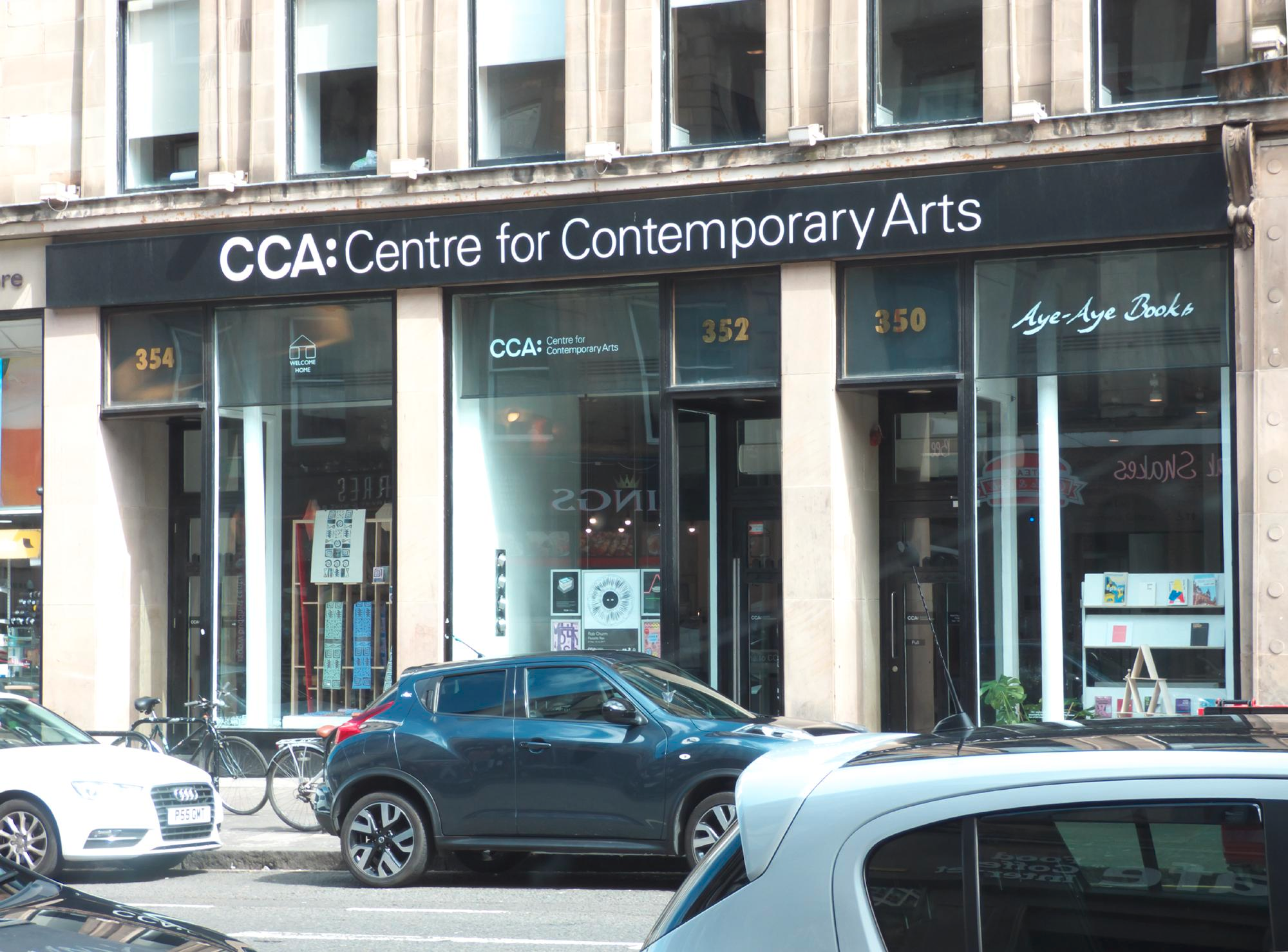
Image Credit: Sam Saunders CC-SA-BY
In recent weeks, the Centre for Contemporary Arts (CCA) in Glasgow has been in the news again after Cabinet Secretary, Màiri McAllan stated that Creative Scotland have “the intention to sell the building as a cultural asset”. The building at 350 Sauchiehall Street is currently owned by Creative Scotland and has been closed since the CCA began an insolvency process in January this year. Creative Scotland have said they are open to either lease or purchase and that plans to operate it for cultural use “were particularly welcome” to submit expressions of interest. These statements seem to demonstrate an intention to keep the building as a cultural space, but do not rule out the possibility of private ownership, making it much harder to protect the long-term purpose.
There are two public bids so far: a group of existing performing arts companies seeking to make a new ‘creation centre and performance venue’; and new organisation ScotsRock hoping to create a rock and roll hall of fame. Several politicians have raised concerns about plans for the future of the building – Patrick Harvie wrote for The National, “we’re in a very dangerous moment”, with concerns about the loss of our cultural infrastructure. A grassroots campaign, Save Our CCA, have criticised the ScotsRock campaign, saying the space should be kept as a multi-arts venue rather than a tourist trap and are calling on supporters to mobilise around retaining the venue as a public asset.
Those who have been following Glasgow’s cultural news will know the CCA is not the only arts space under threat recently. Several organisations in Trongate 103 feared eviction only months ago, after Glasgow City Council’s commercial property management company, City Property, planned to quadruple their rents. GCC have provided a £200,000 Culture and Creative Industry Property Support Fund to provide short-term relief to deal with the increasing costs, but it is unclear what the long-term prospects are.
Last December, the grassroots organisation Theatre 118 was given seven days’ notice to vacate Granite House after it was sold in an off-market deal, with developers fighting residents to turn the building into purpose-built student accommodation. Other public spaces across Glasgow have also been threatened, from the People’s Palace to the Queen’s Park Glasshouses. Each has their own specific nuances, some under council control while others sit with Scottish Government, but the trend is stark: our access to cultural and civic spaces is shrinking as budget cuts and speculative property development takes over.
It could be tempting to say the culture sector needs to put forward its case more, to prove its value, but that work has already been done. The National Planning Framework 4 (NPF4) explicitly includes culture as a national outcome, including a policy stating “development proposals that would result in the loss of an arts or cultural venue” will only be supported where there is no longer a demand for the venue or there is an equal or better alternative.
The Scottish Government’s 2020 Strategy for Culture includes an aim to “develop the conditions and skills for culture to thrive”, and to “place culture as a central consideration across all policy areas”. Glasgow City Council’s own Culture Strategy 2024-2030 includes the outcome “places and spaces for culture across the city are invested in and maintained”.
Culture is also recognised as a human right. It is part of the United Nations Convention on the Rights of the Child (UNCRC), which the Scottish Government has already incorporated into Scots Law in 2024 and the International Covenant on Economic, Social and Cultural Rights (ICESCR) which the Scottish Government aims to be part of the forthcoming Human Rights Bill. Article 27 of the Universal Declaration of Human Rights states that “everyone has the right freely to participate in cultural life and to enjoy the arts”, which Scottish organisation Art27 is working to explore.
So, culture and access to the arts is already recognised as a priority, a right, and a tenet of planning decision-making across policy portfolios and from local to national levels. Why, then, are our venues seemingly under constant threat?
“Community ownership of our cultural spaces could offer a way to escape the risk of quadrupled rents, short-notice evictions by private developers, and the instability of public funding cycles”
While the Scottish Government are keen to talk about their increases to culture funding, research done by Culture Counts demonstrates culture spending has decreased by £10.6m since 2013. While Scottish Government have increased their funding to Creative Scotland to be redistributed throughout the sector, local authority spending on culture has fallen by a greater amount. Funding has been reduced, centralised, and decided at a national level, without the ability for local communities to decide what they need.
Only 27 of the 32 council areas in Scotland have Creative Scotland Multi-Year Funded organisations, receiving the most stable form of public funding for culture. Where issues arise, there is little capacity for nuanced approaches, with results like Creative Scotland defunding Cumbernauld Theatre due to an unsuccessful application, which then had to be propped up with temporary funding to avoid closure. As with Glasgow City Council’s relief for the Trongate 107 tenants, we are seeing temporary, reactive, funding instead of long-term, strategic and developmental approaches to using public funds.
Many of the issues the culture sector faces could, of course, be improved with more money. Increased funding for culture – whether in the form of the basic income for artists, or much-needed capital funding to restore older buildings – will be essential to allow the sector to actually grow after over a decade of austerity and scraping by. But pouring money into an unequal and inefficient system won’t fix it. Changes to working models and ownership, particularly of venues, have the opportunity to make a lasting impact.
Community ownership of our cultural spaces could offer a way to escape the risk of quadrupled rents, short-notice evictions by private developers, and the instability of public funding cycles. It has the potential to democratise and localise the decisions involved, so what is offered is what the people affected actually want, need, and will use. It would take the financial risk away from the public sector which clearly does not want to shoulder that burden, and would place it with the communities who already have a vested interest in seeing their spaces thrive.
The (former) CCA could be a new cultural hub, run as a collective between people who already know what the sector needs, to continue to fulfil the people of Glasgow’s right to culture. While the current prospects are likely either a lease from Creative Scotland or private ownership, the potential of community ownership of cultural spaces should be considered. There would be risks involved, as there are with any new venture, but the risks pale in comparison to the impact of losing the cultural hubs our sector relies on, and there is a wealth of knowledge around community ownership in other parts of our society, from football clubs to villages, and everything in-between.
We are likely to see more political discussion of culture, with the SNP’s manifesto commitment to both the basic income for artists trial and Culture Counts’ proposal for a Culture Act. These offer an avenue for artists and arts-workers to address the range of issues plaguing the sector, but we don’t need legislative change to make better use of what we have. We have mechanisms for community ownership, we have planning policy claiming to support cultural spaces, and we have organised, passionate communities who rally around every threatened public space. Spaces should be run creatively, and venues owned by their communities have the potential to reimagine better futures for all of us.