

Communities have been priced out of owning Scotland
Two new reports show that the rate of land transfers to community ownership in Scotland has dropped to the lowest level since the start of devolution and that a poll of the Scottish public shows near-unanimous support for more land reform over and above that which may be delivered by the recent Land Reform Bill.

Image Source: Tomás Robertson, Unsplash
The recently passed Land Reform Bill is simultaneously “the most radical land reform legislation in the history of devolution” (the Government’s characterisation of it) and so weak that even before it has achieved Royal Assent, 96% of people polled say it doesn’t go far enough and that they want more. Who the other 4% are is not known but they’re probably the kind of person who would answer in the negative to a question like “Are puppies cute?”
How these two statement can both be true and accurate is a reflection not of the strength of the 2025 Land Reform Bill but a reflection of the weakness of the previous round of land reform in 2016.
This Bill was designed to strengthen community right to buy rules laid down in yet still previous land reform attempts in 2015 and 2003, specifically granting Ministers the power to force a compulsory sale of sale to communities for the purposes of sustainable development even if the land owner wasn’t willing to sell or couldn’t be identified.
A few years ago, I wrote an analysis of a report published looking at the rate of transfers of land to Scottish communities since the start of devolution. The results were stark. It found that despite the 2016 round of reforms being specifically aimed at making community land transfers easier, there were serious other barriers looming. In particular, the assets being transferred were getting smaller and smaller even though the overall number of transfers were still proceeding steadily. What this meant is that where before a community might have been able to enact a community buyout of the entire estate on which they lived or their local wind farm, communities were instead only buying out perhaps their village hall or even just the old phone box to turn into a medical station or pop-up craft store.
I’m not berating some of these initiatives as they are undoubtedly a good thing. I’m not even trying to suggest that communities lack ambition in their purchases. I’m saying that they are being blocked from realising their ambition by land prices surges that are making it impossible to purchase land.
One of the aspects of the latest Bill is that communities must be notified ahead of a large land sale and must be given time to put together a purchase bid. But if the price is still so high that they cannot put together the cash regardless of time, then the notice is merely an insult added to the injury.
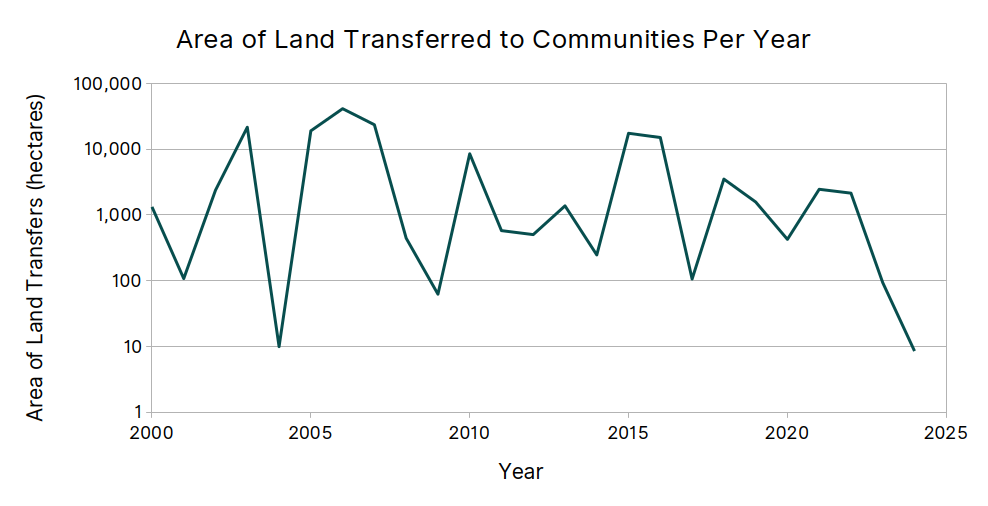
Move forwards three years to now and that community land report has been refreshed and brought up to date. Unfortunately, the results are even worse now. In the years between 2000 and 2023, an average of 7,023 hectares of land were transferred to community ownership each year. In 2024, just 8.46 hectares were transferred to community ownership. This is the lowest rate of transfer in a single year since 2000.
Worse, the total number of transfers has fallen off a cliff too. From a peak of 80 transfers in 2021, Scotland only transferred 23 parcels of land to communities in 2024.
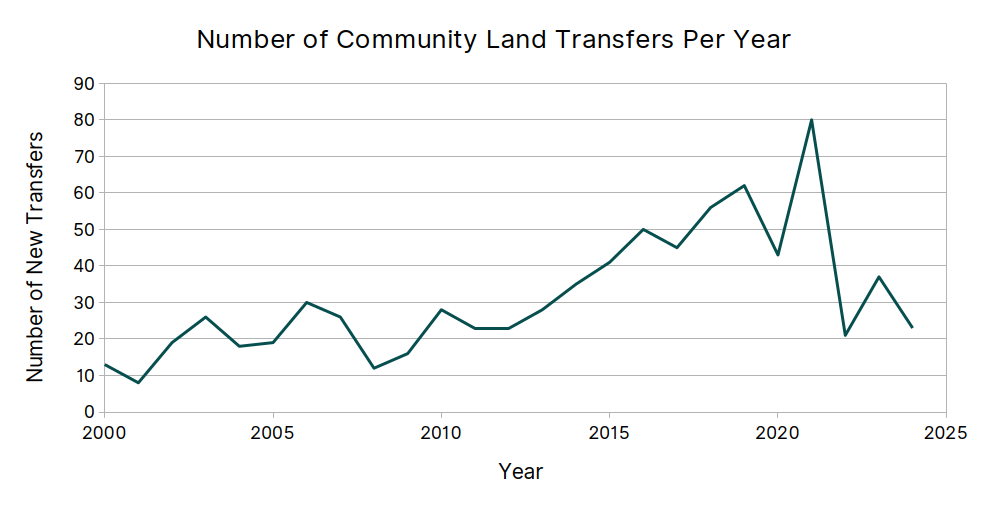
Now, that peak of 80 in 2021 does show some evidence of delays caused by Covid in 2020 but even then, while the country was in total lockdown for much of that year, 43 transfers were made covering 423 hectares. In 2020, during the worst global pandemic of a lifetime, Scotland managed to transfer to community ownership 50 times as much land as it was able to do in 2024.
The drop in 2024 represents a total reversal of the progress made from 2014 which saw a substantial and sustained rise in communities being able to buy the land under their feet. These results show that far from the 2016 Act accelerating land transfers, they have almost halted since then. 95% of all of the land in community ownership in Scotland was transferred to communities before the 2016 Act took effect.
“The latest round of Land Reform clearly won’t be enough to fix this problem and it’s clearly not enough to satisfy what is as close to a unanimous poll of the Scottish public as it is practically possible to find.”
I believe that the reason for this stagnation is the same as the one I noted in 2022. Scottish land prices are being inflated beyond any reasonable expectation by speculators going all in on buying up land for carbon offsetting, encouraged by a Scottish Government that is similarly all in on encouraging “foreign direct investment” as the sole tool of boosting Scottish GDP, regardless of the cost to our future economy or our present communities.
The thing is though, I wonder if the votes on the Land Reform Bill might have been different had this latest report been public knowledge before it passed. It would have been valuable leverage for those campaigning for strong powers of community buyouts in that Bill. It might well have led to amendments designed to counter this trend of people being priced off the land.
I wonder why the Government didn’t publish this report then or even allude to its findings via its own amendments. I’m fairly sure that they would have had advance knowledge of the findings of the report to some degree (I know this because I recently had a Freedom of Information request on another issue knocked back on the excuse that while the Government had the data, it was due to be published anyway within a couple of months – which it duly was). Yet little was said during the various debates around this Bill.
The latest round of Land Reform clearly won’t be enough to fix this problem and it’s clearly not enough to satisfy what is as close to a unanimous poll of the Scottish public as it is practically possible to find. This is clearly an issue that must be revisited in the next Parliament. We’ll be keeping a close eye on manifestos as they are published and, of course, we’ll continue to campaign (with your support) for real land reform so that Scotland can start working for All of Us, rather than just the very few who can afford to buy the land under our feet.
