

Following the Scottish Government’s decision to refuse the proposed Coul Links golf development, Not Coul examines what this case tells us about the balance between economic growth and environmental protection, and why Scotland’s natural heritage must not be sacrificed for private gain.
Profiteering versus nature. An ancient, one-sided conflict. Each ransacking leaves behind a distinct flavour of destruction. Deforestation, oil slicks and nuclear fallout feel old-fashioned now. Today it’s melting glaciers, forever chemicals, and even data centres. All are symptoms of one problem: private gain built on externalised costs.
Development usually happens at a seemingly inconsequential local level. But costs multiply at local, national and global scales and cannot be ignored: climate change, rising seas, habitat & species loss.
The mistake is believing it’s a trade-off: prosperity or conservation. A false choice. Yes, we need business, but while all development has effects, some are acceptable, some not.
That’s why designations exist. They’re a rational answer to the long-recognised societal problem of achieving economic progress whilst minimising socio-economic costs.
Designations come in an alphabet soup of acronyms: SSSI, SPA, SAC, etc. Plus Ramsar Wetlands, National Parks and World Heritage sites. Each legally protects places differently. They hold in common the power to protect nature from inappropriate development.
It isn’t a question of whether we should have an economy. What kind of economy do we want?
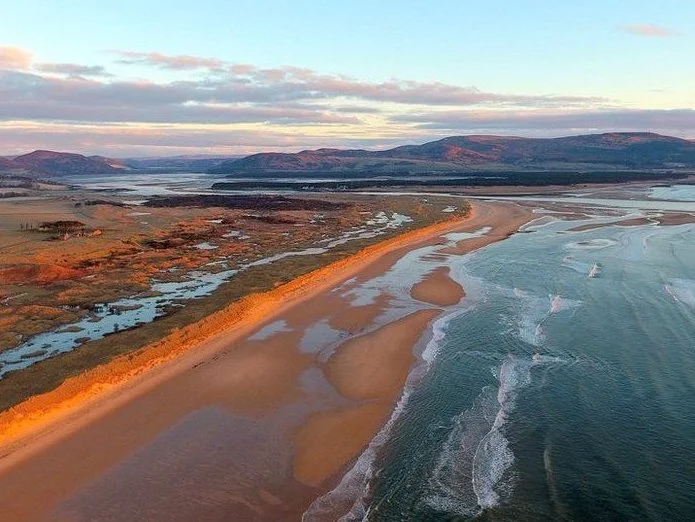
Coul Links is an exceptional coastal wetland and intact dune system. An intricate mosaic of habitats, supporting an extraordinary 1,425 species. Aside from limited grazing, it has remained remarkably undisturbed for millennia. Not a wasteland, but a jewel in the crown of Scottish biodiversity. Far from being newly discovered by wide-eyed golf tycoons, it has long been identified as having natural wealth worth protecting.
Coul is, therefore, triple-protected as a Site of Special Scientific Interest (SSSI), a Special Protection Area (SPA) and a Ramsar Wetland of International Importance.
Each designation carries legal weight, with Ramsar now underpinned by Habitats Regulation Assessment. This stringent test ensures developers must “demonstrate, beyond a reasonable scientific doubt, that the proposed development would not adversely affect the integrity” of the site.
Additionally, Scotland’s National Planning Framework 4 requires significant consideration to be given to climate & biodiversity crises.
It is this peaceful wetland, however, which billionaires and an absentee landlord planned to convert into a golf course. For the past decade, Coul Links was where the battle line between cashing in and saving Nature was drawn. Ministers have now put an end to that conflict in favour of Nature, but it was never a guarantee.
As formidable as they sound, designations are not impenetrable defences. Developers have breached them before; the Scottish Government infamously granted Donald Trump a golf course on Menie’s protected dunes.
The case showed that the force of designations lies not just in their legal strength, but also in the quality of expertise and the rigour with which decision-makers apply due process.
While citizens and conservationists rally around designations, developers drill for weakness elsewhere, widening the battlefield beyond the legal framework to the political sphere. This reframes designations as hurdles, not boundaries.
In the case of Coul Links, the developers and their PR agents had designed a narrative to politicise and undermine its designations.
“Designations aren’t hoops to jump through. They mean something. They’re a line in the sand, evidence-based and legally defined”
Developer narrative — we're local, honest, and we know best, we have an awful economy and chronic depopulation (ethos), but this nationally significant vision of a golf course, hotels and partly-affordable housing could reverse that awful trend and keep our youth here, which is what we all want (pathos), and, as for the designations, well, let's say the site is overrun by invasive species because NatureScot is underfunded and this development could actually pay for its restoration (logos).
The reality — with a surplus of hospitality jobs in the locality, work is there for the taking. Does the local economy need more of the same? Census figures show population numbers rising in East Sutherland, which is why the developer likes to hide them within county-wide figures instead. The supposedly “nationally significant" portfolio is a lobbying ruse, with no existing planning application for any housing. In any case, 50 houses, even together with a course and hotel, would not transform the local economy. Dornoch has half a dozen hotels, hundreds of new houses and three courses. Our own audited research into the ecology of the site, submitted to Ministers, showed that the developer misidentified and exaggerated invasive species three-fold. And, rather than being neglected by NatureScot, it’s the landlord who obstructs his own agreement with the agency, as discussed during the inquiry.
The idea that Coul Links must be developed to ‘save’ the natural assets within is doublethink. Nor can we accept that protection obstructs economic progress. That’s an impoverished view of economics, based on the assumption there is only one possible economic model in which we "make nature pay for itself", as the developer’s botanist said.
At this time in history, there is nothing progressive anymore about extracting profit from a natural asset while degrading the ecological systems that give it value. It’s this remarkably old-fashioned, ideological approach akin to 19th-century laissez-faire economics which got us into this conflict to begin with. We can do better.
Protecting nature doesn’t mean self-inflicted economic misery. There’s enormous scope for wealth creation without slicing up the last remaining sanctuaries for Nature. A modern economy can comfortably operate within the sensible restrictions of designated sites like Coul Links.
Designations aren’t hoops to jump through. They mean something. They’re a line in the sand, evidence-based and legally defined. It’s a collective decision for the good of Society to protect Coul Links, and two public inquiries agree. Upholding that decision, as Ministers have done, does not impede Scotland’s future — it’s part of building one.