

How to solve Glasgow’s derelict buildings problem
In this week’s In Common, Rory Hamilton discusses the Union Street fire that has sparked debate about vape shop regulation, and the real story that lies in Glasgow’s deeper dereliction crisis. As property speculation leaves historic buildings empty across the city, the question is now whether the rubble becomes another stalled site or a catalyst for a different vision of Glasgow’s future.
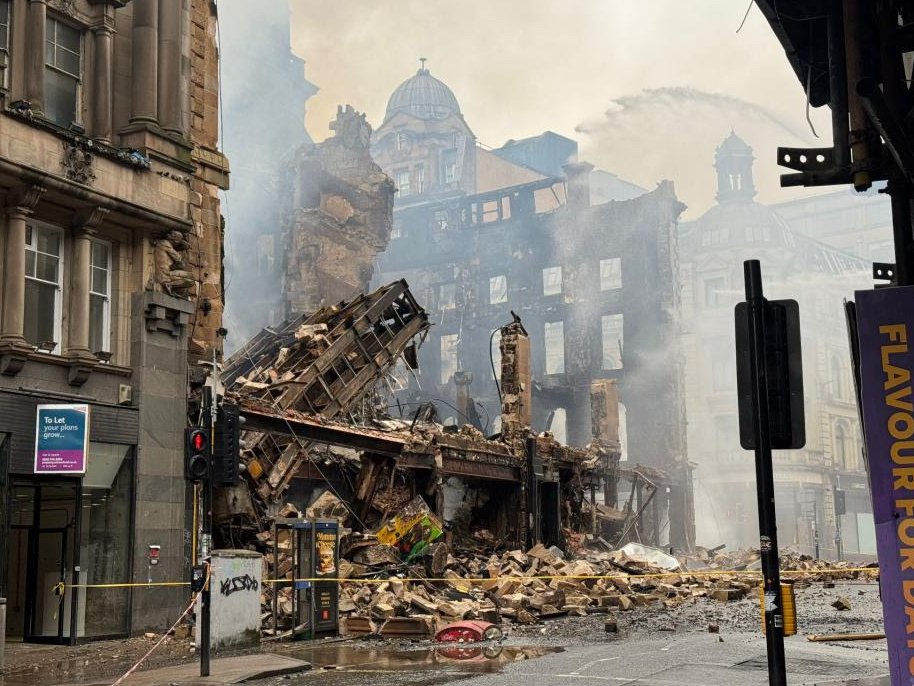
You’d have to be pretty cold-blooded not to feel an ounce of shock or devastation at the charred remains of the Union Street buildings next to Glasgow Central Station that burned down last weekend.
For many in Glasgow, it might feel that that we’ve been here before, notably the two fires at the Glasgow School of Art, with the question, "why does this keep happening" a justified one on the lips of the city’s inhabitants.
Speculation on causes has been rife this past week, with new information dripping through about the legitimacy of the vape business that is pointed to as the source of the fire. The early conclusions are that clearly greater regulation of vape shops is needed. Take your pick as to why: From the public health risk (why do we forbid cigarette shops but allow vape shops), the light-touch framework in comparison to alcohol retailers, the enforcement of current checks, to the broader implications of these shops on the high street (storefront designs about as ugly as the American candy store shops Keir Starmer began legislating against), and the implication of satisfactory storage of highly flammable goods on historic listed buildings.
However, only focusing on regulation of the cause of this fire would be a mere sticking plaster to a broader problem across the UK of high streets sucked of their soul.
Once the rubble is cleared and conversations begin about what happens to the derelict site next will tell us a lot about the economic logic of Glasgow City Council and what it sees as the vision for the city’s future.
It is well-acknowledged that Glasgow has a dereliction problem, being the Scottish city with the highest percentage of its population living within 500m of derelict land. That’s why for many Glaswegians the what comes next part will feel all too familiar: Another derelict site left to rot, leaving behind crumbling visions of a grand past, tied to empire and slavery of course, but one which symbolises some level of success for the city.
Whether it’s the Egyptian Halls (opposite the site of the fire), or the former Lyceum Cinema in Govan, the Met Tower, Carlton Place, or previously the O2 ABC, facades of former glory are left to remind the people of Glasgow: “Look at what you once had, or indeed what you could have.”
Prolonged dereliction like this sucks the soul out of a place, and reduces the sense of belonging experienced by those who live there. No wonder, far-right parties like Reform target so-called "left behind places" and do so by praying on a sense of nostalgia. The imagery of a kind of forgotten past remains all around but the neglect by political classes now inhabits them in the form of boarded up shops, empty buildings, and drab soul-less shopping centres replacing once grand department stores, train station ticket offices, or even hotels.
But why is this problem so concentrated in Glasgow, and what to do about it?
Put very simply, Glasgow’s economic strategy revolves around retail – guaranteed money for prominent property locations in city centre which can attract a revenue stream. However, the only thing more guaranteed than a revenue stream (particularly in an age of low disposable income, i.e. wages)? Speculation on the notional value of a property. As much property is owned by equity funds as speculative investments, it is often in their interest to keep the place empty in the name of waiting on a subsequent rise in property prices so they can sell the property on for a greater return on investment.
Attracting investment to Glasgow city centre, therefore, has been about releasing the maximum profit from the land, either through car parks, luxury housing, retail and office space (in this case), or student flats.
As my colleague Robin McAlpine argued rather eerily some months back: “A historic two-storey building is much more valuable as charred rubble than as a building. You immediately have land to speculate on, even if it is a weed-strewn mess for years and years. You don't want social space; if there is space, you make it private, you build on it, you make people pay to use that space.”
We need a clamp down on commercial property values which have been inflated over the years thanks to this approach. Not only will this enable ordinary Glaswegians (as opposed to distant property developers) to restore a sense of meaning to the heart of the place they call home, but the broader economic impacts of this could range from bringing down rents for tenants, to bringing about the replacement of council tax with a fairer system of property and land tax.
Out of the rubble of Union Street comes the opportunity to reorient the Glasgow economy towards serving the interests of Glaswegians.